Tree Removal in Garner, NC
Dead, dying, leaning, storm-cracked, or just planted in the wrong place forty years ago: when a tree has to go, we take it down safely, clean up completely, and price it in writing before we start.
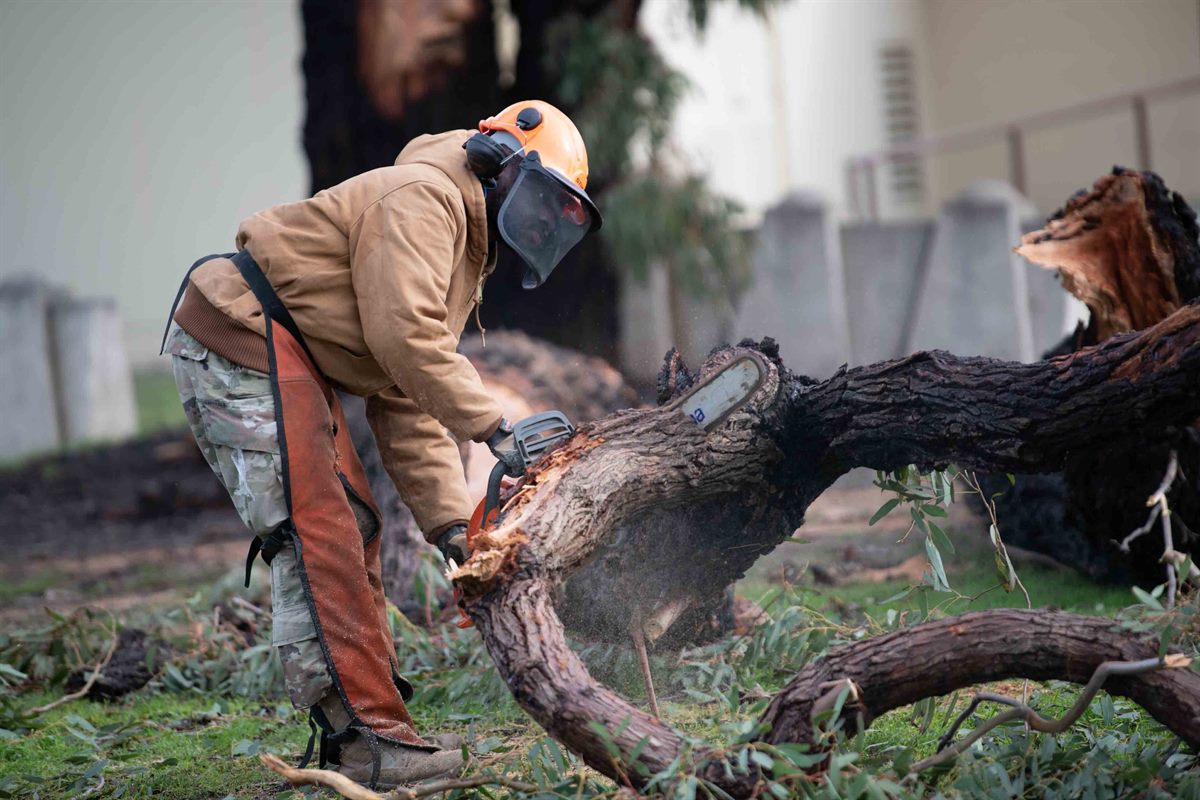
When a tree crosses from asset to liability
Nobody removes a healthy, well-placed tree for fun. The trees we take down around Garner have usually crossed a line: a water oak shedding limbs onto the driveway, a loblolly pine dead from bark beetles and drying into a hundred-foot spear, a sweetgum leaning harder every year toward the kitchen, or a Bradford pear that split in the last thunderstorm and is holding itself together out of habit.
The economics are simple. A planned removal is a controlled, scheduled job. The same tree through your roof is an insurance claim, a tarp, weeks of contractors, and an emergency removal at storm rates. When a tree is genuinely failing, taking it down on your schedule is almost always the cheaper version of the story.
Why removals in this area are rarely simple
Garner's older neighborhoods, Vandora Springs, Heather Hills, the streets off Aversboro Road, grew up under willow oaks and water oaks that now stand sixty to eighty feet over houses, fences, sheds, and service drops. There is no empty field to drop a tree like that into. It comes down in sections: a climber or lift works from the top, limbs are roped and lowered, and the heavy trunk wood is rigged away from everything you care about.
The soil adds its own complication. Wake County's Cecil red clay saturates in heavy rain, and root plates lose their grip in it, which is why storm-leaning trees here need to be treated as live hazards rather than curiosities. A tree that moved once can move again, and we sequence those jobs so nobody is ever under the load.
Dead trees cost more for a reason
A dead or rotten tree cannot be climbed and rigged the way sound wood can; it fails unpredictably under load. Depending on how far gone it is, that means a lift, a crane, or slower piece-by-piece work from an adjacent position. If you are watching a tree decline, calling while it still has sound wood is the single best way to keep the price down. Our cost guide breaks down exactly how condition moves the number.
What the written quote covers
Every quote starts with a walk of the property. We look at the tree, the targets under it, the access for equipment, and anything fragile in the work zone, then hand you a written scope that spells out:
- What comes down, whole trees or specific ones, flagged so there is no ambiguity.
- How: felled whole where there is room, rigged down in sections where there is not, crane-assisted when the math calls for it (see large and technical removals).
- What happens to the wood: chipped and hauled by default, or bucked and stacked if you want firewood.
- The stump: ground 6 to 12 inches below grade as an add-on, or left, your call. Details on the stump grinding page.
- The price, one number, before anything is scheduled.
Ask for proof of insurance before you let anyone start, and ask every company you get a number from. Any crew you let take a chainsaw sixty feet over your house should hand you a certificate of insurance without being prompted; it is the fastest way to separate real outfits from the trucks that appear after storms.
Where we work
Garner is home base, and the same crews cover the east and south belt: South Raleigh, Knightdale, Clayton, Wendell, Zebulon, and Fuquay-Varina. The tree stock changes town to town, old in-town oaks, pine buffers against new construction, fence-line hardwoods on rural edges, but the process is the same everywhere: free on-site quote, written price, complete cleanup.
Tree types that come down around Garner
The trees we work with most often have their own situations and price points:
Willow oak and water oak: Garner's problem children
Garner's oldest neighborhoods planted these decades ago for shade. Now at 60 to 80 feet, they dominate the canopy. A healthy one is beautiful; a declining one is a hazard. Water oaks especially get heavy lateral branches and take longer to rig down safely than a straight pine. If you have a water oak dropping dead limbs or leaning toward your roof, it is time to call: these trees are slower to remove and harder to delay on.
Loblolly pine: common, often beetle-killed
East Garner has pine buffers, and they are usually the easiest removals we do. A straight pine 50 feet tall often drops whole into open space. But if it is brown from the top down, drought-stressed from 2020-2022, or beetle-killed, it cannot be climbed safely and needs different rigging or a lift. Dead pines look like money-savers because they are small; they are actually money-spenders because they are unsafe to work.
Sweetgum, hickory, and pecan: harder to work
These hardwoods have messy branch structures and split easily. A sweetgum is slower than an oak at the same height because every limb has to be managed separately. We do them, but expect the price to be on the higher end of the range for that size.
Real Garner tree removal situations
Every tree that comes down has a reason. These are the common ones in this area:
Water oak after summer storm, leaning 45 degrees
A thunderstorm Wednesday night loosened the root plate. The tree is still standing but visibly tilted. Root plate lift is visible on one side. This is the worst kind of problem because the tree looks almost normal until it is not. Storm damage to a tree is permanent: if it moved once, it will move again. Leaving it standing is waiting for the tree to decide to fall on something, which is not a gamble to take. Cost: high end of the range for that tree size because the wood is compromised and every limb has to be rigged with extreme care.
Dead loblolly pine, standing since the drought years
The tree turned brown in 2021 or 2022 during the extended drought. It is still standing, but the wood is rotten and unpredictable. It looks like a small removal because the tree is 50 feet, not 80. It prices like a big removal because it cannot be climbed and needs a lift or slower piece-by-piece work from the ground. Act before it gets worse; a dead pine you can still climb is cheaper than one that is fully rotted.
Water oak hanging over the roof, spreading lateral limbs
The limbs are heavy and extending. Pruning might buy a year or two. Removal is right if the tree is unhealthy (crown thinning, dead wood, mushrooms at the base) or if the limbs are the tree's natural shape and it will only grow closer. We tell you which on the walk-through.
Bradford pear split in a thunderstorm
Bradford pears split easy. One storm and they are holding themselves together by bark. Removal is quick but necessary; a half-split tree is a failure waiting to happen. Cost: low to medium for the size because the tree is small and comes down fast.
The written quote covers this process
Every quote starts with a walk of the property. We look at the tree, the targets under it, the access for equipment, and anything fragile in the work zone. Then we tell you the scope, in writing:
- Which trees: Marked or described so there is no ambiguity on job day.
- The method: Whole tree drop where there is room, rigged sections where there is not, crane if the math calls for it.
- The access plan: How equipment moves in, how we protect your yard, what lawn damage to expect (sawdust and tire marks, not ruts and craters).
- The wood: Chipped and hauled by default, or bucked for firewood if you want it stacked on site.
- The stump: Ground 6 to 12 inches below grade as an add-on, $100 to $400 depending on diameter, or left in place for later if you prefer.
- The price: One number, confirmed in writing, no surprises on job day.
Insurance documentation comes with the quote as a matter of course, not because you asked. That is the separation between professionals and the trucks that show up after storms.
What tree removal typically costs in Garner
Most single removals here run $500 to $2,000. Small ornamentals are $300 to $600. Large water oaks or technical removals over structures run $1,500 to $6,000 and up. The Garner tree removal cost guide breaks down pricing by tree type, size, condition, and situation so you can estimate before the quote. Access, condition (healthy vs dead), and what is underneath the tree are the biggest drivers, not just height.
Not sure removal is the answer?
Sometimes it is not. A structurally sound tree with an overextended limb problem is a pruning job, not a removal, and pruning costs a fraction as much. When we walk a property we tell you which situation you actually have, because talking someone out of an unnecessary removal is how a local company stays trusted in a town this size. If you want to sanity-check prices first, start with the Garner tree removal cost guide, then get the free quote.
Frequently Asked Questions
How much does it cost to remove a tree in Garner?
Most single-tree removals around Garner run $500 to $2,000. Small ornamentals can come in around $300, and large or technical removals over a house or power drop run $2,000 to $6,000 and up. The price drivers are size, condition, what is underneath the tree, and how hard it is to get equipment to it. We give you a written number after walking the property, and it does not change on job day.
How do I know if my tree actually needs to come down?
The strong signals: large dead limbs or a thinning crown, mushrooms or soft rot at the base, a new lean or lifted soil on one side after a storm, trunk cavities, and woodpecker activity concentrated in one area. Water oaks past about 60 years old deserve extra suspicion. If the tree is healthy and just too big, pruning may be the better answer, and we will say so.
Will the removal tear up my yard?
Protecting the yard is most of the skill. We rig sections down instead of dropping them when anything is below, use plywood mats for equipment where the ground is soft, and stay off septic fields entirely. Expect some sawdust and tire marks on a big job, not ruts and craters. Cleanup, raking included, is part of the standard scope.
Do you take the trunk and branches away?
Standard scope is everything gone: brush chipped, logs hauled, yard raked. If you want firewood we buck the trunk to length and stack it, which trims the price. Either way the choice is written into the quote so there is no confusion on job day.
Is the stump included?
The stump is quoted as its own line, typically $100 to $400 per stump depending on diameter. Grinding it during the same visit is the cheapest option. Some homeowners skip it and decide later, which is fine too; the price to come back is only slightly higher.
Do I need a permit to remove a tree in Garner or nearby towns?
On private single-family residential lots in Garner, Knightdale, Clayton, Wendell, Zebulon, and Fuquay-Varina you generally do not need a permit. Street right-of-way trees, development-related buffers, and HOA rules are the exceptions. A quick call to your town planning department clears it up, and our permit guide on the blog walks through the details.
Got a tree that needs to come down?
Start with a free on-site quote and an up-front written price. Serving Garner and the east Raleigh belt.