Tree Trimming & Pruning in Garner, NC
Most trees do not need to come down; they need weight off the ends, deadwood out of the crown, and daylight between the limbs and your roof. Good pruning buys a mature tree another decade and costs a fraction of a removal.
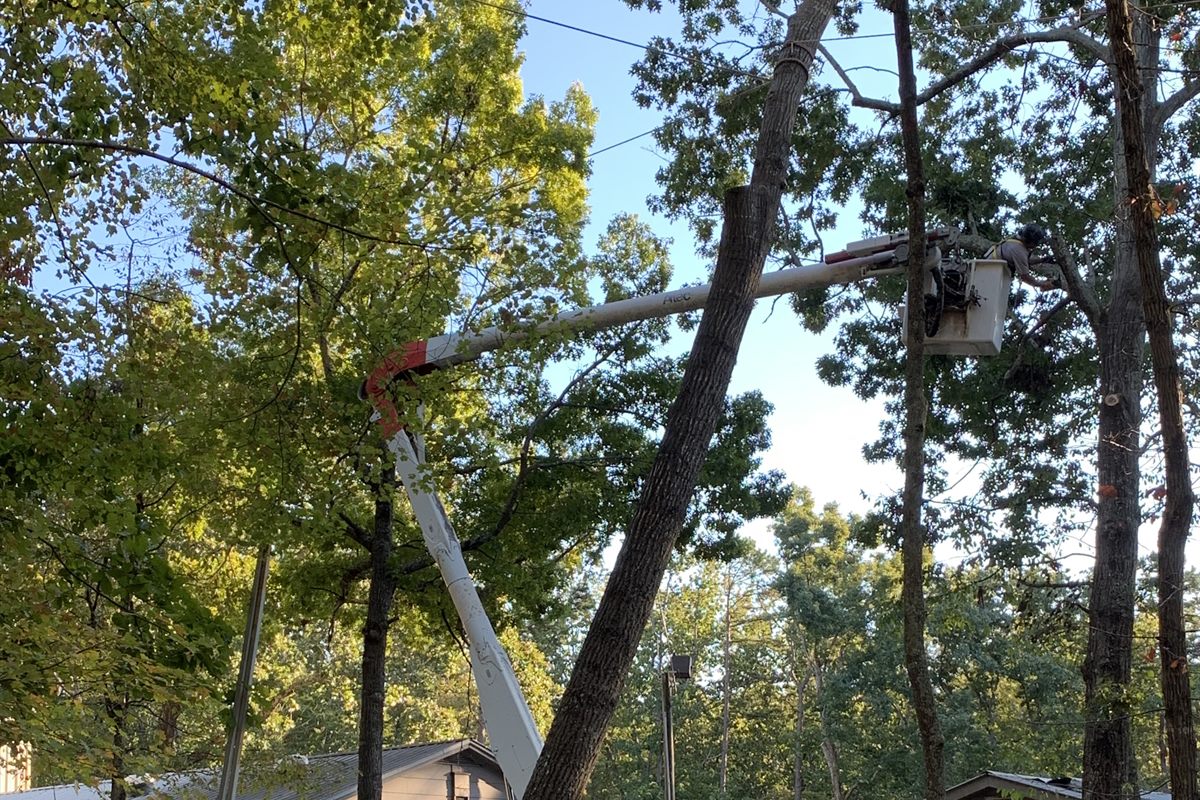
Pruning is the cheap version of tree safety
Most storm failures started as a trimming job nobody did. The limb that came through the sunroom in a July thunderstorm was overextended for years. The water oak that dropped a widow-maker on the driveway had been carrying visible deadwood since the last ice storm. A few hundred dollars of pruning, done at the right time, is how mature trees and houses keep coexisting, and it is dramatically cheaper than the storm-week cleanup or the full removal that neglect eventually books.
What we actually do in the crown
- Deadwooding: removing dead and dying limbs before gravity does it for you. The single highest-value cut in older Garner oaks.
- Crown thinning: selectively removing interior growth so wind moves through the canopy instead of pushing on it like a sail. This is the storm-season play for big willow oaks on saturated clay.
- Clearance pruning: lifting limbs off the roof, the chimney, the driveway, and the service drop, with proper cuts back to laterals so the fix lasts more than one season.
- End-weight reduction: shortening overextended horizontal limbs, the classic failure point on maples and Bradford pears, back to strong lateral branches.
- Structural pruning on young trees: an hour of work on a ten-year-old tree prevents the codominant-stem splits that wreck thirty-year-old trees.
What we do not do is topping. Cutting main stems back to stubs is tree vandalism: every stub becomes a rot column, and the regrowth that erupts around it is weakly attached and heavier every year. If a tree genuinely needs to be shorter, there is a right way to do it, and if the right way cannot make it safe, we will tell you it is a removal conversation.
What pruning costs in Garner
Trimming is the cheapest tree work you will ever buy, and the spread inside the range is almost entirely about height and access rather than about how many limbs come off.
| Job | Typical 2026 range | What it covers |
|---|---|---|
| Single limb removal or clearance cut | $300 to $500 | One overextended limb off a roof, driveway or fence line |
| Deadwooding a mature hardwood | $400 to $900 | All dead and dying limbs out of the crown, climbed or from a lift |
| Crown thinning, 50 to 70 ft tree | $600 to $1,200 | Interior thinning so wind moves through rather than pushing |
| Full crown clean, large willow or water oak | $900 to $1,500 | Deadwood, thinning and end-weight reduction in one visit |
| Structural pruning, young tree | $300 to $500 | Correcting codominant stems before they become a split |
Those are planning ranges for this market, not quotes, and the full picture by tree size sits on the Garner cost page. The number that matters when you compare quotes is not the total: it is whether the scope says which limbs and which cuts. A cheap number attached to "trim the oak" is not a quote, it is an invitation to argue on job day.
When pruning is the wrong answer
Pruning solves problems in the canopy. It does nothing for problems in the trunk or the roots, and that is the distinction worth understanding before you pay for either.
- Basal rot or a trunk cavity: pruning does not reach it. Taking weight off the top slightly reduces the load on a compromised stem, which is a real but small benefit on a tree that is failing from the bottom up.
- A lifting root plate: cracked or heaved soil on the side opposite a lean means the anchoring is going, and no amount of crown work fixes anchoring. That is a leaning tree question rather than a pruning one.
- Beetle-colonised pine: loblolly and shortleaf are the species most susceptible to southern pine beetle, the signs are a browning crown and S-shaped galleries under the bark, and the tree is on a clock once both appear. Pruning a colonised pine spends money on a tree that is leaving.
- A dead tree: dead is dead. If the cambium is brown at every spot you check, you are buying a removal, not a trim.
If more than roughly a quarter of the live crown has to come out to make a tree safe, pruning has stopped being the answer. We will say so in the quote and put the removal number beside it, because the useful thing is the comparison rather than the cheaper line.
Trimming near the power lines
This is the part that costs homeowners money through simple confusion about whose wire is whose, and the boundary is the opposite of what most people assume.
Duke Energy states that where a tree interferes with the service line running from the pole to your meter, the property owner has primary responsibility for keeping it clear. The lines running pole to pole down the street are Duke's, and per North Carolina Utilities Commission rulings Duke may cut trees within 16 feet of its right-of-way that could fall and take out a transformer line, particularly dead or ailing ones.
The useful part: Duke will de-energize your service line at no cost on request before tree work happens around it. Ask for that before anyone climbs, because only qualified line-clearance personnel should be working near an energized line. A tree touching a live line right now is a call to Duke's 24-hour emergency number rather than to us; we do not run an after-hours crew. The whole boundary is in our guide to what Duke trims and what you own.
Timing matters more than people think
The dormant window, February into early March, is prime pruning time in the Triangle: structure is visible, cuts seal fast when growth resumes, and it lands conveniently ahead of the spring storm season. Summer is fine for deadwood and clearance work. What we avoid is heavy pruning during the August heat stress or taking more than about a quarter of the live crown in any season; over-pruned trees respond with exactly the weak, fast sucker growth you were trying to get rid of.
The species around here have habits
Willow oaks want thinning, not shortening. Water oaks past middle age need honest deadwood assessments every few years, because they hide rot well. Loblolly pines mostly need nothing until they need everything; watch for browning tops and beetle pitch tubes instead of pruning them cosmetically. Bradford pears need their tight V-crotches relieved before wind does it, and crape myrtles need exactly none of the brutal February chopping the shopping centers model, a proper crape myrtle prune keeps the natural form.
Signs it is time, rather than next year
Most people call about pruning after a storm. The cheaper moment is before one, and these are the tells worth acting on:
- Limbs touching or scraping the roof, siding or gutters. Contact wears through shingles and gives squirrels a bridge.
- A cluster of dead branches in the upper canopy, as opposed to the scattered lower deadwood mature hardwoods shed routinely.
- Long horizontal limbs with all their weight at the far end, the classic failure geometry on maples and Bradford pears.
- A tight V-shaped union between two main stems, especially with bark pinched into the crotch. That is a split waiting for wind.
- Canopy so dense that nothing grows underneath and wind cannot pass through it.
- Limbs over a driveway, a play area, or anywhere people habitually stand. Target matters more than limb size.
What a pruning quote should spell out
Ask for these five things in writing and the comparison between bidders becomes straightforward:
- Which tree and which limbs. Marked, flagged or described specifically enough that there is no argument later.
- What kind of cuts. Deadwooding, thinning, clearance or reduction are different jobs at different prices.
- Where the debris goes. Chipped and hauled, chipped and left, or bucked and stacked all cost differently.
- Whether the utility needs involving, and who is making that call.
- Proof of insurance. Ask us and ask every other bidder, and ask before anyone climbs. A certificate names the insurer, the policy number and the dates, so you can check it. "We are covered" is not the same thing.
Anyone knocking on your door during storm week asking for cash up front, with out-of-state plates and no local address, is the pattern to wave off regardless of the number.
Where we trim
Same belt as all our work: Garner, South Raleigh, Knightdale, Clayton, Wendell, Zebulon, and Fuquay-Varina. Trimming quotes are free and specific: which limbs, which cuts, what it costs, in writing. If a tree is past the point where pruning solves it, the quote says that instead, with the removal number next to it so you can decide with real information. Pricing context is in the cost guide, and the quote itself is a call or form away.
Frequently Asked Questions
How much does tree trimming cost in Garner?
Most residential trimming jobs run $300 to $1,500 depending on the size of the tree, how much is coming out of the crown, and how close the work is to the house and lines. A single overextended limb is the low end; a full crown clean on a 70-foot willow oak is the high end. Like everything we do, the price is written before work starts.
When is the best time of year to prune in North Carolina?
Late winter, roughly February into early March, is the sweet spot for most species: the structure is visible without leaves, the tree seals cuts fast when spring growth starts, and pests are dormant. Dead, broken, or hazardous limbs are the exception; those come off whenever you find them. Oaks especially benefit from dormant-season pruning.
How much can you take off a tree at once?
The working rule is no more than about a quarter of the live crown in one season, and less for older trees. Taking more stresses the tree into throwing weak sucker growth, which makes the problem worse in three years. If a tree needs more than that removed to be safe, the honest conversation is whether it should be a removal instead.
Do you top trees?
No, and you should be suspicious of anyone who offers to. Topping, chopping the main stems back to stubs, ruins the structure, invites rot into every cut, and produces dense, weakly attached regrowth that is more dangerous than what you started with. Reducing height correctly is done with proper cuts back to lateral limbs.
My limbs are over the neighbor’s yard or near the power line. What then?
In North Carolina you generally have the right to trim branches back to your property line, and disputes are covered in our blog guide on fallen-tree responsibility. Anything near the utility service lines is a different category: Duke Energy handles clearance around their primary lines, and we work the rest of the tree safely around the drop to your house.
Got a tree that needs to come down?
Start with a free on-site quote and an up-front written price. Serving Garner and the east Raleigh belt.