What Duke Energy Trims and What You Own
Garner Tree Removal • September 15, 2026 • 8 min read
There is a limb growing into the wire that feeds your house, and you have two questions: is that the power company’s problem, and what happens if I touch it. Around Garner and the east Raleigh belt this comes up constantly, because loblolly pines run 80 to 100 feet along property lines and the wires were strung under them decades ago.
The short version is that the answer depends entirely on which wire you are looking at, and most homeowners are looking at the one that belongs to them. This guide covers where the boundary sits, what Duke Energy will do for free, and what the work costs on your side of the line.
Every figure here is a planning range for this market, not a quote.
Who Is Responsible for Trees Near Power Lines?
The line running from the pole to the meter on your house is yours to keep clear, and Duke Energy says so directly: where a tree interferes with that service line, the property owner has primary responsibility for keeping it clear of vegetation. Everything upstream of that, the lines running pole to pole down the street, is Duke’s.
That single distinction settles most of the confusion. Here is the whole boundary:
| The wire | Who keeps it clear | Notes |
|---|---|---|
| Transmission lines (the tall steel towers) | Duke Energy | Managed on their own cycle, wide cleared corridors |
| Distribution lines (pole to pole along the street) | Duke Energy | Per North Carolina Utilities Commission rulings, Duke may cut trees within 16 feet of its right-of-way that could fall and take out a transformer line, and trees farther out that pose a risk, particularly dead or ailing ones |
| Service line (pole to your meter) | You | The drop that feeds your house. This is the one in your yard, and it is the one people assume is Duke’s |
| Storm debris on your property | You | Duke does not clean up tree debris from severe weather. Disposal of wood, limbs and debris from emergency operations is the property owner’s responsibility |
So the limb resting on the wire above your driveway is almost certainly your responsibility, and the crew that showed up to cut back branches near the street was doing Duke’s work, not yours.
Pro tip: Duke Energy will de-energize your service line at no cost so tree work around it can be done safely. If you or a contractor are working near that line, call and request it before anyone starts. It is free, it is the single most useful thing in this guide, and almost nobody knows to ask.
What Duke Energy Actually Does, and When
Duke runs planned pruning cycles on its own lines rather than responding to individual requests on a schedule you control. In North Carolina, Duke notifies customers a minimum of three days before planned pruning begins, so a door hanger or a letter is usually the first sign a crew is coming.
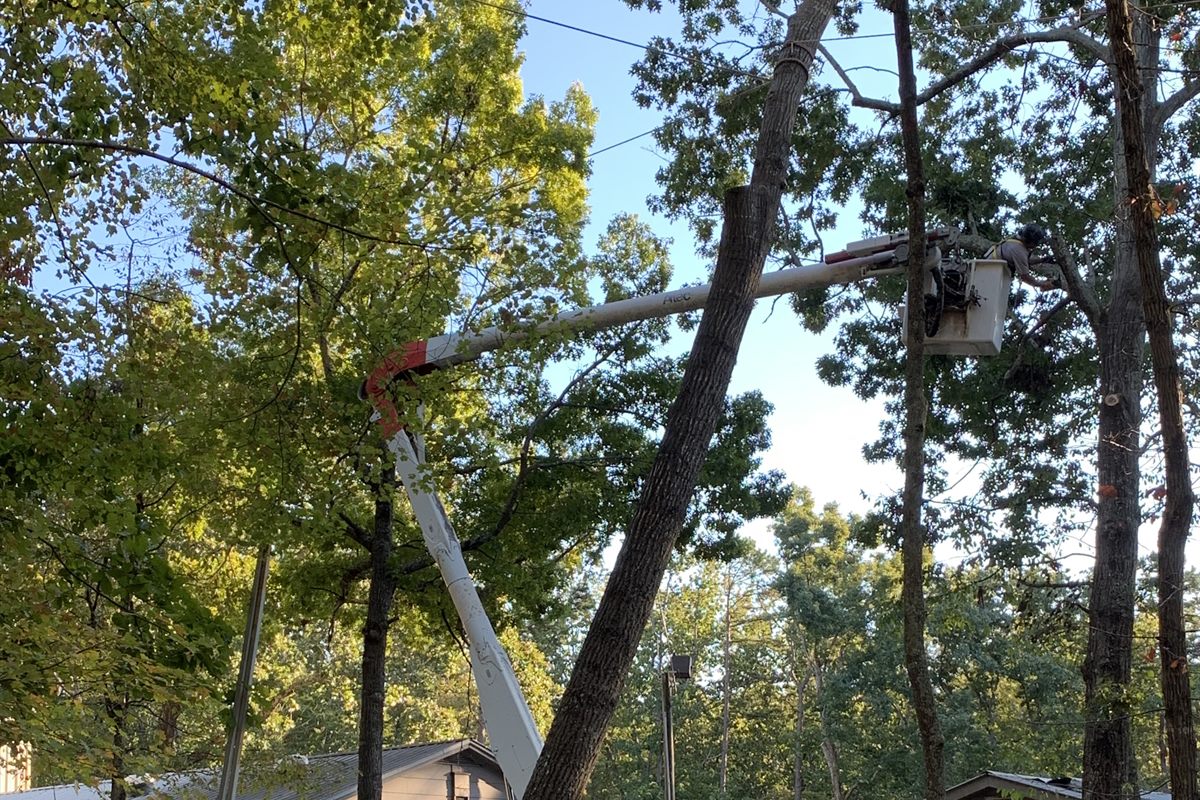
Two things worth knowing about how that work looks when it happens. First, only qualified line-clearance personnel should take down trees near electrical lines, which is why the crew doing it is a specialist contractor rather than a general tree service. Second, the cuts are made for line reliability, not for the shape of your tree, so a pruned tree near a distribution line often looks lopsided afterwards. That is the tradeoff, and it is not something a homeowner gets to negotiate.
For an active hazard, a line down in the yard, arcing, or anything smoking, Duke runs a 24-hour emergency line. That is the number to call, not a tree company. We do not run an after-hours crew, and no tree service should put a saw near an energized line regardless.
Want the number for a planned request instead? Duke’s vegetation management and rights-of-way pages carry the current contact routes for pruning requests and right-of-way questions, and the customer service centre will refer you to a vegetation management or right-of-way specialist for your specific property.
What It Costs on Your Side of the Line
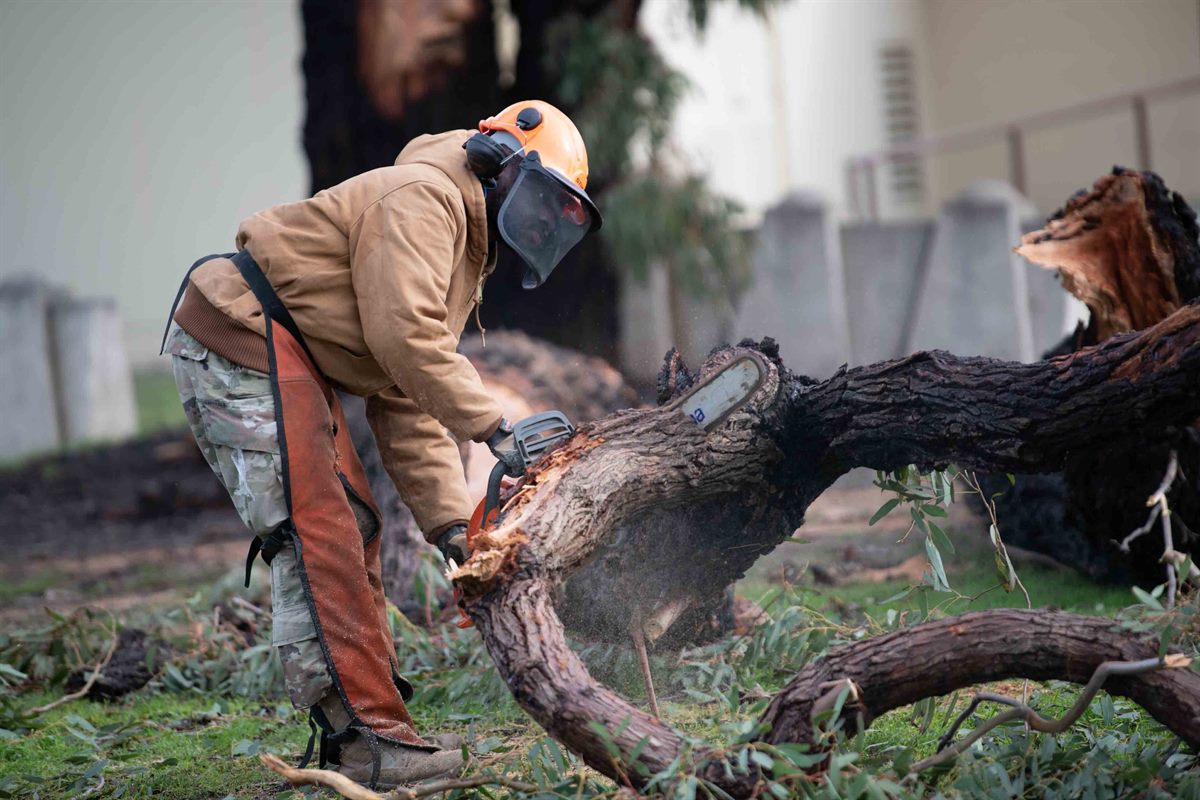
Once the line is de-energized, a tree growing into your service drop is ordinary tree work, priced like any other job by size and access.
| Work | Typical 2026 range |
|---|---|
| Clearance pruning on a mature tree | $300 to $1,500 |
| Small tree removal, under 30 ft | $300 to $800 |
| Medium tree removal, 30 to 60 ft | $500 to $1,500 |
| Large tree removal, 60 to 80 ft | $1,500 to $3,000 |
| Technical or rigging work over a structure | $2,500 to $6,000+ |
Those are the same bands as any planned job; the Garner cost guide breaks them down by tree size and access. A loblolly growing through the service drop is usually a pruning job rather than a removal, which is the cheap outcome. What pushes it into removal territory is condition: a pine already stressed and hosting southern pine beetle is not worth pruning around, because the tree is on its way out anyway.
Want the exact number for your tree? Request a free written quote and we walk the property, then price it in writing.
When the Tree Is the Real Problem, Not the Branch
Pruning a limb off the wire fixes this month. It does not fix a tree that is going to fail into the wire.
Southern pine beetle is the reason to look harder at pines specifically. Loblolly and shortleaf are the species most susceptible, the beetle usually attacks trees at least 15 years old, and it goes primarily for trees already stressed by drought, disease, competition or age, though it will attack healthy trees too and can kill several hundred acres in a single outbreak. The signs to look for are a browning crown and S-shaped galleries under the bark. A pine showing both, standing over your service line, is a removal conversation rather than a pruning one.
Water oaks deserve the same scrutiny for a different reason. NC State Extension puts the species at 30 to 50 years and notes it can start breaking apart at maturity from rot, which is why it is often not recommended for urban planting. The water oaks that went in when the neighborhoods off Aversboro Road and around Vandora Springs were built are at or past that age.
Do You Need a Permit to Cut a Tree Near a Line?
Permits and utility clearance are two separate questions, and the utility answer does not settle the permit answer.
On the permit side, requirements vary by parcel, scope and jurisdiction, and the town or county office makes the determination. NC State Extension’s guide for municipalities lists existing or proposed single-family detached dwellings on individually owned lots among the standard exemptions from tree protection rules, so single-family lots are commonly exempt, and what normally triggers those rules instead is new development, expansion, or a change of land use. Commonly is not universally: the exemption is written into each ordinance. Call the town before you cut anything you are unsure about, and treat that call as free insurance.
On the utility side, none of that matters until the line is de-energized. Do that first.
Frequently Asked Questions
Will Duke Energy remove a whole tree for me?
Not as a service to you. Duke manages vegetation for line reliability on its own lines, and may remove trees within or near its right-of-way that threaten distribution infrastructure, particularly dead or ailing ones. A healthy tree in the middle of your yard that you want gone is your project, not theirs.
Who pays if a tree takes down the line to my house?
Restoring the utility’s own equipment is Duke’s work. The tree, the debris and any damage on your property are yours, and Duke states plainly that it does not clean up storm tree debris. This is general information, not legal or insurance advice; your policy and your insurer decide what is covered in your specific case.
Can my regular tree service work around the service line?
Only after it is de-energized, and only if they are set up for it. Only qualified line-clearance personnel should take down trees near electrical lines. The de-energizing call to Duke is free, so there is no good reason to skip it.
Does Duke Energy trim in Knightdale and Clayton the same way?
Yes. The pole-to-meter boundary and the three-day notice before planned pruning are Duke’s North Carolina practice, not a town-by-town policy, so it reads the same in Knightdale, Clayton, Wendell and across Raleigh.
The crew cut my tree into a bad shape. Can I get that fixed?
Not by Duke, and corrective pruning after a utility cut is limited by what is left. A tree that has had a third of its canopy taken off one side to clear a line is often better removed and replaced than reshaped. The tree removal cost guide covers what that costs by size.
How do I tell a Duke contractor from a storm chaser?
Duke gives a minimum of three days notice before planned pruning, so a legitimate crew is not a surprise. Anyone knocking on the door during storm week asking for cash up front, unable to show a certificate of insurance, with out-of-state plates and no local address, is the pattern to walk away from.
Tree Work Near the Line in Garner and East Wake
Once Duke has the service line de-energized, the rest is straightforward: clear the limb, or take the tree if condition says take it. That is ordinary tree removal in Garner and the belt around it. We quote removal, pruning and stump grinding across Garner, Knightdale, Clayton and Wendell, with an up-front written price before anything starts.
Request a free written quote or call (919) 322-8083 during business hours. For a line that is down, arcing or smoking right now, call Duke Energy’s 24-hour emergency line instead. That one is genuinely urgent, and it is not a tree company’s job.
Sources: Duke Energy: Distribution Line Vegetation Management · Duke Energy: Rights of Way FAQ · NC State Extension: Protecting and Retaining Trees · NC Forest Service: Southern Pine Beetle Prevention Program · NC Extension Gardener Plant Toolbox: Quercus nigra