Can I Cut My Neighbor's Tree Branches in NC?
Garner Tree Removal • September 20, 2026 • 9 min read
The willow oak next door has thrown a third of its canopy over your driveway, and the limbs now sit close enough to the roof that you can hear them on a windy night. You have mentioned it twice. Nothing has happened. So the question turns practical: can you cut your neighbor’s tree branches yourself, and how far does that right actually reach?
Around Garner and the rest of east Wake County this comes up constantly, because the houses and the trees grew up together. Ranch homes on quarter-acre lots, water oaks and willow oaks planted near the lot lines decades ago, and sixty years later two canopies meeting over somebody’s fence.
This is general information, not legal or insurance advice; ask an attorney about your own situation and your insurer about anything that touches a claim.
Below: what North Carolina lets you cut, the three places that right stops, who pays, what happens if the cut kills the tree, and the two situations where the rule changes entirely. Every price here is a planning range, not a quote.
Can I Cut My Neighbor’s Tree Branches in NC?
Yes. You may cut branches and roots that cross the property line onto your land, back as far as the line, at your own expense. No permission is needed and no court order is involved. Lawyers call it the self-help rule: an encroachment onto your land is yours to deal with on your side of the line.
What the rule does not do is hand you any authority over the tree itself. It is a right to cut back what reaches you. It is not a right to manage, reshape or remove somebody else’s tree.
| You may | You may not |
|---|---|
| Cut limbs back to the vertical plane of the property line | Cut past the line, even by a few inches |
| Cut roots where they cross onto your land | Step into the neighbor’s yard without permission |
| Hire a crew to do the work from your side | Fell the tree, or top it |
| Do it without asking first | Cut so hard that you kill or destabilize the tree |
| Keep or dispose of the wood you cut down | Send the neighbor the bill |
Want the number before you commit to anything? Request a free written quote and we walk the property, then price the work in writing.
Where the Self-Help Right Stops
Three limits do all the work here, and every neighbor dispute we hear about in Garner, Clayton and Knightdale comes from crossing one of them.
The property line is a vertical plane
Picture a sheet of glass standing on the boundary and running straight up. You may cut everything on your side of that glass. Nothing on the far side is yours to touch, which means no reaching over to take the stub off flush against the trunk, and no cutting a limb that originates on your side back into their crown for a tidier shape.
Trespass is still trespass
The right to cut does not include a right to stand where you need to stand. If the only safe way to make the cut is from the neighbor’s yard, from their driveway, or with an outrigger on their grass, you need their permission first. Most people say yes when asked. Almost nobody says yes when they come home and find a truck already parked on the lawn.
You may not kill the tree
This is the limit people trip over, because it is not about where you cut but how much. Strip one side of a mature oak and you can put the whole tree into decline or leave it unbalanced enough to fail. Destroying a neighbor’s tree can make you liable for its value, and a mature hardwood in an established neighborhood appraises for far more than most people expect.
What Happens If the Trim Kills the Tree?
The liability flips to you. Up to the moment of the cut, a hazardous neighbor tree is their problem. After a bad cut, a tree that fails may be traced to the pruning rather than to the weather, and the person holding the saw owns that conversation.
There is no magic percentage that makes it safe. Arborists judge how much live canopy a particular tree can lose in one season by its species, age, vigor and the season itself, and a certified arborist is the one qualified to set that number for a specific tree. What is reliably true: taking a heavy share of the live crown off one side of a tree, all at once, in mid-summer, is the version that goes wrong.
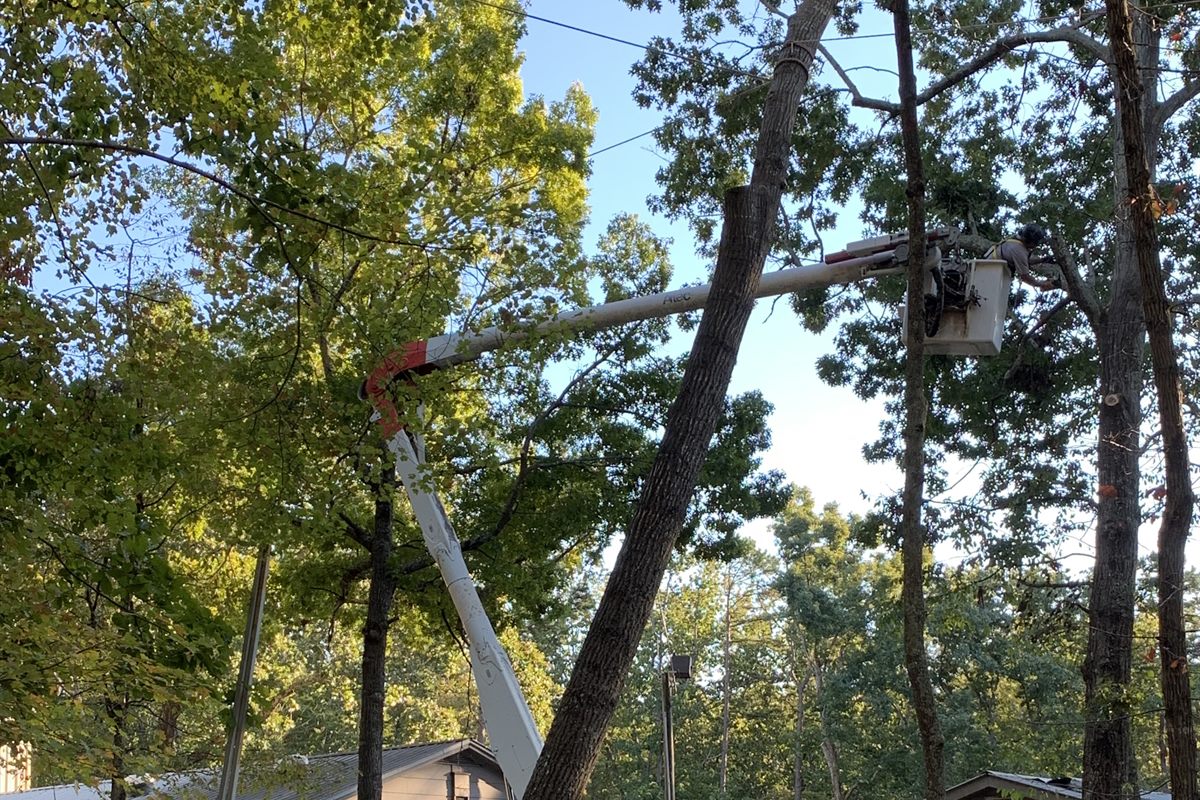
Two practical consequences. First, the bigger the tree, the more this matters; on anything above pole-pruner height, use a professional trimming crew rather than a ladder and a Saturday. Second, tell the neighbor before the work rather than after. A five minute conversation converts most of these into a shared job, and a shared job means one crew, one mobilization and one invoice split two ways.
Who Pays to Trim the Overhanging Branches?
You do. The self-help right is a right to spend your own money. North Carolina does not give you a mechanism to bill a neighbor for cutting back a healthy tree’s overhang, however inconvenient the overhang is.
| Work | Typical 2026 range |
|---|---|
| Trimming and pruning | $300 to $1,500 |
| Small tree removal, under 30 ft | $300 to $800 |
| Medium tree removal, 30 to 60 ft | $500 to $1,500 |
| Large tree removal, 60 to 80 ft | $1,500 to $3,000 |
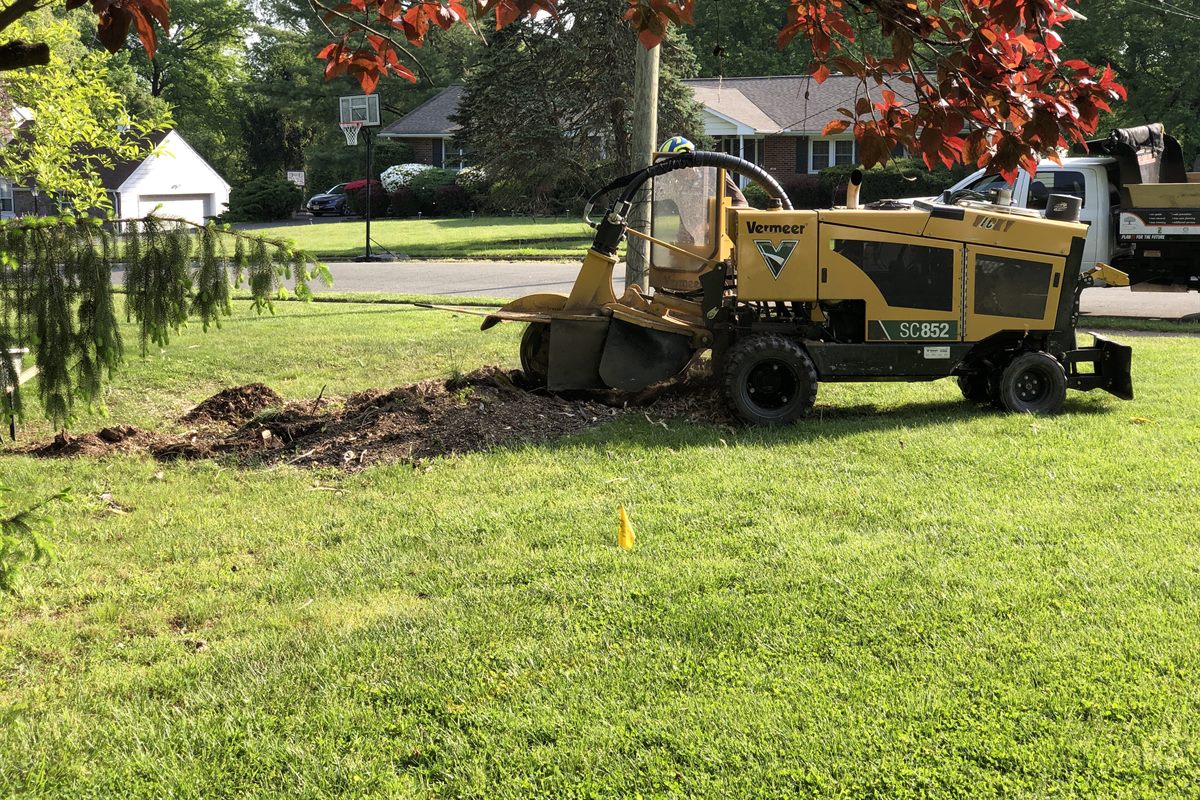
| Stump grinding | $100 to $400 per stump |
Planning ranges for this market, not quotes. Where the work sits inside the trimming band depends on height, how much rigging is needed to get limbs down without hitting a fence or a roof, and how much debris leaves the property. Full breakdowns sit on the Garner cost page and in the tree trimming cost guide.
Pro tip: ask the neighbor for access before you ask for money. Working from their side is usually faster and safer than reaching over a fence, which often drops the price, and a homeowner who has agreed to let a crew in has effectively agreed the work is reasonable. That is a much better starting point than a cold request to split a bill.
Two Situations Where the Rule Changes
Most overhang questions are simple. Two are not.
The limb is dead, or the whole tree is defective
Then you are no longer in trimming territory, you are in liability territory. North Carolina applies the ordinary common law negligence standard to falling trees rather than strict liability, and the hinge is whether the owner had actual or constructive notice of the dangerous condition. A healthy tree that drops a limb in a storm is an act of nature; a dead one the owner was warned about is a different case. Our guide to who is responsible for a fallen tree in NC is the full explanation, and if the tree next door is visibly dying, the useful move is putting the hazard in writing rather than reaching for a saw.
Cutting a dead limb back to the line is still within your rights. It does not make the tree safe, and it may weaken the written record you would otherwise be building.
The branches are on the line running to your meter
The service line from the pole to your meter is the property owner’s responsibility to keep clear of vegetation, not Duke Energy’s. Lines running pole to pole are theirs. If you or a crew are working near your service line, Duke Energy will de-energize it at no cost on request, and that call happens before any saw comes out. Only qualified line-clearance personnel should be taking trees down near energized conductors. Our guide to what Duke Energy trims and what you own covers the boundary in detail.
And one more: the trunk may not be theirs at all
If the trunk sits on the boundary rather than beside it, the tree is not the neighbor’s tree, it is both of yours, and the self-help rule stops applying the way you expect. Who owns a tree on the property line explains what changes.
Frequently Asked Questions
Can I cut my neighbor’s tree branches without telling them?
Legally you generally may, for the part that crosses the line onto your property. Practically it is the single most reliable way to start a dispute in a neighborhood like Wendell or Garner, where lots are close together and everyone sees the truck arrive. Tell them, and the work usually gets easier and cheaper.
Do I have to pay to trim branches that hang over my yard?
Yes. Cutting back the overhang is at your own expense, and trimming and pruning runs $300 to $1,500 depending on size and access. Some neighbors split it voluntarily, which is a favor rather than a debt.
What if the overhanging limb is dead and might come down on my car?
That is the negligence exception rather than the trimming question, and the answer is to create a written record before it falls, not after. Photograph it, put the concern in a dated message, and keep the copy. Our fallen tree responsibility guide explains why notice decides these cases.
Can I keep the firewood from branches I cut?
The wood you cut on your own side is generally yours to deal with, and most people either have it chipped or keep it. If you want it processed rather than hauled, say so when you book, since logs split and stacked is a different work order than chip and go.
What if my neighbor trims my tree badly from their side?
They have the same right to cut to the line that you do, and the same limit on killing the tree. If their cutting damaged or destabilized a tree whose trunk is on your land, photograph it, keep the dates, and speak to an attorney before the tree is removed and the evidence goes with it.
Do you trim branches right at the property line?
Yes. We quote tree trimming and pruning at the line, and tree removal when the tree has gone past the point where trimming helps. What we do not do is judge whether a tree is hazardous; that assessment belongs to a certified arborist.
Line Trimming and Tree Removal in Garner and East Wake
Whether the limbs are yours, theirs, or genuinely on the line, the work is the same: get a crew that will put the scope in writing before anything is cut. We quote trimming, removals and rigging over structures across Garner, Knightdale, Clayton and Raleigh, with an up-front written price and a scope you can show a neighbor.
Request a free written quote or call (919) 322-8083 during business hours and we will walk the property with you, mark what comes off, and price it before anybody starts.
Sources: NC Pro Bono Resource Center: Disaster Assistance Manual, Falling Trees, Flying Limbs and Loud Neighbors · Law Firm Carolinas: Liability for Fallen or Threatening to Fall Trees · Duke Energy: Distribution Line Vegetation Management