Can You Plant a Tree Where a Stump Was?
Garner Tree Removal • September 20, 2026 • 9 min read
Losing a shade tree from a Garner front yard changes the whole look of the house, and the first instinct is to put a new one back in the same spot. So can you plant a tree where a stump was, or is that hole ruined for good?
It is not ruined. It is just full of wood you cannot see. A standard grind takes the stump down 6 to 12 inches, which is the right depth for a lawn and nowhere near enough for a root ball. The difference between a replacement tree that establishes and one that sulks for three years is almost always what is sitting 18 inches down where nobody looked.
This guide covers what the grinder actually leaves, how far off the old stump to plant, how deep the grind has to go if you insist on the same spot, which species not to put back, and when to plant in central North Carolina. Any figures below are planning ranges for our area, not quotes.
Can You Plant a Tree Where a Stump Was?
Yes, and the easy version is to offset the new tree 3 to 6 feet from the old trunk rather than planting into the hole. If it has to go in the same spot, the stump needs a deeper, wider grind than standard and the grindings need to come out before the root ball goes in.
That offset is the whole trick. Three feet of lateral movement puts your planting hole into undisturbed soil, away from the old root plate and away from the nitrogen-poor pocket the grindings leave. Nobody looking at the yard in five years will know the tree moved.
What the Grinder Actually Leaves Behind
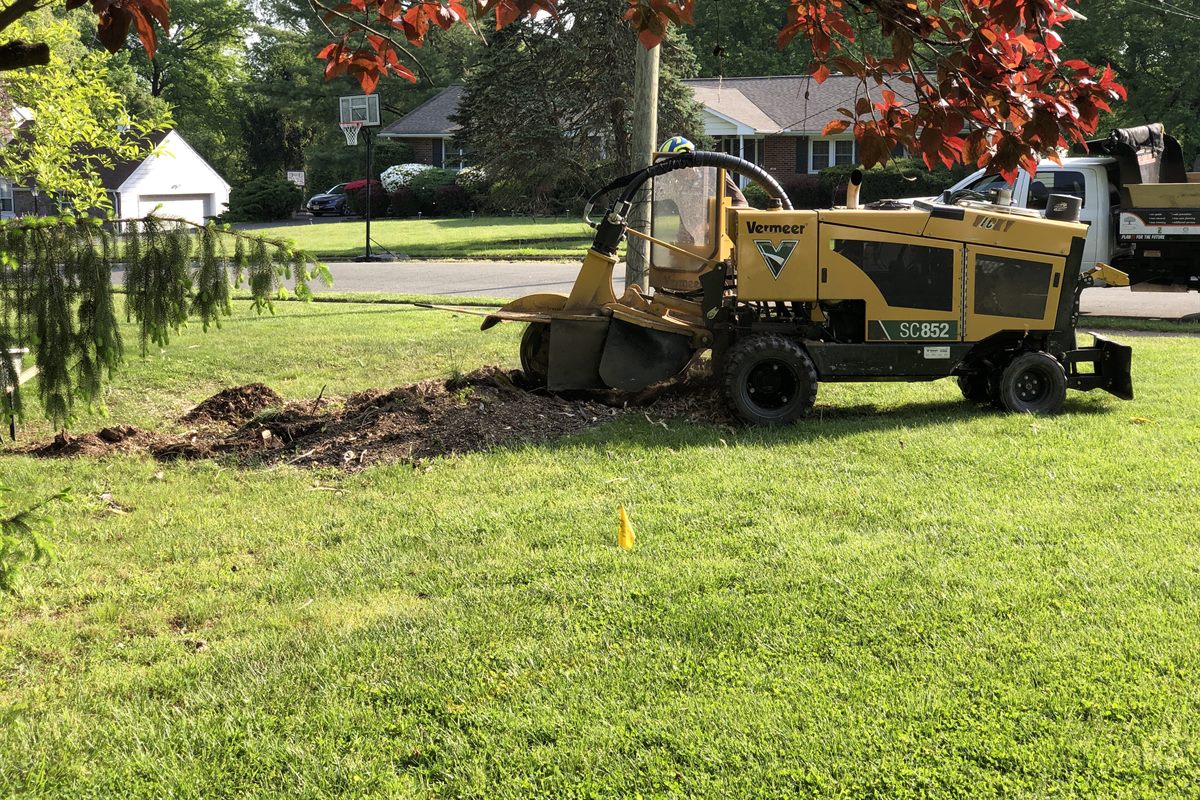
Grinding is mechanical removal of the stump to 6 to 12 inches below grade. It does not touch the root system, and that is by design rather than a job half finished.
What stays in the ground is the root plate directly under the old trunk plus the lateral roots running out under the lawn, often well past where the canopy used to end. On a mature willow oak those laterals can be wrist-thick 10 feet from the trunk. They decay on their own over years, and while they do it they hold soil, which is genuinely useful on a slope.
For a new tree, that leftover wood causes three problems. The root ball hits solid material and the hole ends up too shallow. The decaying wood pulls nitrogen from exactly the zone the young roots are trying to colonise. And the whole area settles unevenly as the old roots go, which can leave a new tree sitting low in a dish that holds water against the trunk flare.
How Far Off Should the New Tree Go?
Match the offset to what you are planting, not to the size of the old tree.
| Offset from the old trunk | What you are planting into | What to do |
|---|---|---|
| Straight into the hole | Grindings, root plate, nitrogen-poor pocket | Only with a deep grind and full removal of the wood |
| 1 to 2 feet | The edge of the root plate | Still awkward; you will hit major laterals digging |
| 3 to 6 feet | Mostly undisturbed soil | The sweet spot for most yards |
| 8 feet or more | Clean soil, different sight line | Ideal if the spacing still works with the house |
On a tight lot you may not have 3 feet to give, and that is when the grind depth matters. Ask for it when you book the stump, not afterwards.
Planning a replacement after a removal? Request a free written quote and tell us a tree is going back in, because it changes how we grind.
How Deep Does the Grind Have to Be to Replant?
Plan on roughly 18 inches or more, and wider than the old flare, rather than the 6 to 12 inches a lawn needs. A container tree from a Triangle nursery wants a hole two to three times the width of the root ball and no deeper than the ball itself, and you cannot dig that if you are standing on old stump wood.
A deeper, wider grind takes longer and pulls up a lot more material, so it prices at the upper end of the $100 to $400 per stump range rather than the bottom.
The grindings also need to leave rather than go back in the hole, and that haul-away adds $50 to $150.
Both are cheaper bought on the original stump grinding visit than as a second trip, which carries a trip minimum of $100 to $150 on its own. Bands for all of it sit on the Garner cost page.
Pro tip: say “we are replanting here” on the first phone call. A grind for grass and a grind for a root ball are two different jobs with two different prices, and the only expensive version is finding out after the machine has gone home and you are standing in a hole full of chips with a balled tree in the driveway.
Which Trees Should You Not Put Back?
Two categories, and one of them is a Garner-specific argument worth having.
Anything that died of a root disease. If the tree came out because something was killing it from the roots rather than because you wanted it gone, the soil is the problem and not the hole. Replanting the same species into it is asking for a repeat. A certified arborist does that diagnosis; we can tell you what the wood looked like coming down, which is often the first clue.
The species that got you here. Around Garner the default replacement is whatever the neighbours have, and that is how a street ends up with one species and one failure mode. Water oak is the cautionary case: NC State Extension puts its lifespan at 30 to 50 years, calls it weaker-wooded than most oaks, and notes it can start to break apart at maturity from rot, which is why it is often not recommended for urban planting. Willow oak does better, running about 80 to 90 years in urban conditions against well over 100 in the woods, but it is still a big tree that wants room.
| The tree you lost | Worth thinking about before you replant |
|---|---|
| Water oak | Short-lived and prone to breaking apart at maturity; consider a longer-lived shade tree instead |
| Willow oak | Fine species, but give it space away from the house and the drive, not the same 15 feet |
| Loblolly pine | Fast and tall; think about what it will be leaning over in 30 years |
| Anything killed by root disease | Change species, and move the planting spot if you can |
Choosing what goes back in is a separate exercise from getting the stump out, and we walk through it in our Garner tree replanting guide.
When Should You Plant in Central North Carolina?
Fall, for most trees and shrubs. NC State Extension’s county horticulture programmes point at roughly mid-September through early December: the soil is still warm, the air is cool, rain is more reliable, and the tree spends the winter pushing roots instead of leaves. Transplant shock is lower and the watering burden is far lighter than a spring planting.
That timing lines up neatly with stump work. A removal in late summer, a grind booked at the same time, a few weeks for the ground to settle, and the new tree goes in during the fall window. If the stump came out in March, fill and level the spot, keep it watered through the summer, and plant in the autumn rather than fighting a July drought with a stressed root ball.
If grass rather than a tree is going over the spot, the method is different and simpler, and it is covered in can you plant grass after stump grinding.
Frequently Asked Questions
Can I plant directly into the grinding hole?
Only if the grindings have been dug out and replaced with soil, and the grind went deep enough to clear the root ball. Otherwise you are planting into wood chips, which dry out fast, settle unevenly, and starve the young roots of nitrogen for a year or two. Offsetting a few feet is nearly always easier.
How long should I wait before planting a new tree?
If the grindings are out and the hole is backfilled with soil, you can plant as soon as the fill has settled and been watered in, which is weeks rather than months. If the chips went back in the hole, give the spot a year or two and expect to top it up as it sinks. The species matters too, because willow oak, water oak and hickory chips take years rather than months to break down.
Do leftover roots stop a new tree from growing?
They slow it rather than stop it, mostly by taking up the space and the nitrogen the new roots want. Young roots find their way around old wood. The real risk is the planting hole ending up too shallow because the shovel hit a lateral and you called it deep enough.
Should I replant the same species?
Not if the old tree died of a root disease, and not automatically otherwise. A yard in Wendell or Zebulon that lost a water oak at 40 years is better served by something longer-lived, given NC State Extension’s 30 to 50 year figure for that species.
Does the old root system need to come out completely?
For a lawn or a new tree, no. Full extraction of the root plate is excavation work with a machine, it tears up everything around it, and it is worth it for a building footprint rather than a planting hole. We compare the two approaches in stump grinding vs stump removal.
Can you grind deeper than standard?
Usually yes, depending on access and what is underground. Utility locates come first, and rock or a shallow water line can cap the depth. Say what you are planting when you ask, and it goes on the quote with the tree removal or large tree removal work rather than as a surprise.
Replacing a Tree in Garner, Wendell and Fuquay-Varina
A stump ground for grass and a stump ground for a replacement tree are two different jobs, and the only way to get the right one is to say which you want before the machine arrives. We grind stumps across Garner, Wendell, Zebulon and Fuquay-Varina, quote the depth and the haul-off as separate lines, and give you an up-front written price before anyone starts.
Request a free written quote or call (919) 322-8083 during business hours, and mention the new tree.