Stump Grinding vs Stump Removal Explained
Garner Tree Removal • September 20, 2026 • 9 min read
The tree is down and the quote in your hand says “stump removal”, but the crew turns up with a grinder. Those are not the same thing, and the gap between them is the most common misunderstanding in this trade. Stump grinding vs stump removal is a real choice with real consequences for your lawn, your budget and what you can build on that spot afterwards.
Most Garner yards want grinding. A smaller set of jobs, usually anything involving a footing or a trench, genuinely needs the whole root plate out of the ground. Getting the wrong one is expensive in opposite directions: you either pay for excavation you never needed, or you pay twice when the ground has to be opened again.
This guide puts the two side by side, explains what each one leaves behind, sets out when full extraction is actually required, and covers what each costs around here. Any prices below are planning ranges for our area, not quotes.
Stump Grinding vs Stump Removal: What Is the Difference?
Stump grinding is mechanical removal of the stump to 6 to 12 inches below grade, leaving the root system in the ground to decay on its own. Stump removal, properly meant, is excavation: the stump and the main root plate come out whole, leaving a large hole that has to be backfilled.
The loose use of the word “removal” is why people get confused. Plenty of companies, this one included, list the service as stump grinding and removal, meaning “we get rid of the stump”. If it matters to you which method is being quoted, ask, and get the answer in writing.
The Two Methods, Side by Side
| Stump grinding | Full stump removal | |
|---|---|---|
| Machine | Purpose-built grinder, tracked or towed | Excavator or backhoe |
| What leaves the site | The stump, ground to chips | The stump, the root plate and the soil around it |
| What stays in the ground | The lateral root system | Very little near the trunk |
| Depth reached | 6 to 12 inches below grade, deeper on request | Below the root plate, often several feet |
| The hole left | A shallow dish | A crater needing real backfill |
| Damage to the lawn | Localised, usually a track path and the dish | Extensive, including the machine route in and out |
| Time on site | Often under an hour per stump | Most of a day once backfill and cleanup are counted |
| What you can do after | Mow, seed, replant with a deeper grind | Build, trench, pour, regrade |
| Cost | Per stump, published bands | Per job, quoted individually, and higher |
Not sure which one your project needs? Request a free written quote and say what is going on that spot afterwards, because that single answer decides the method.
What Grinding Does, and What It Does Not
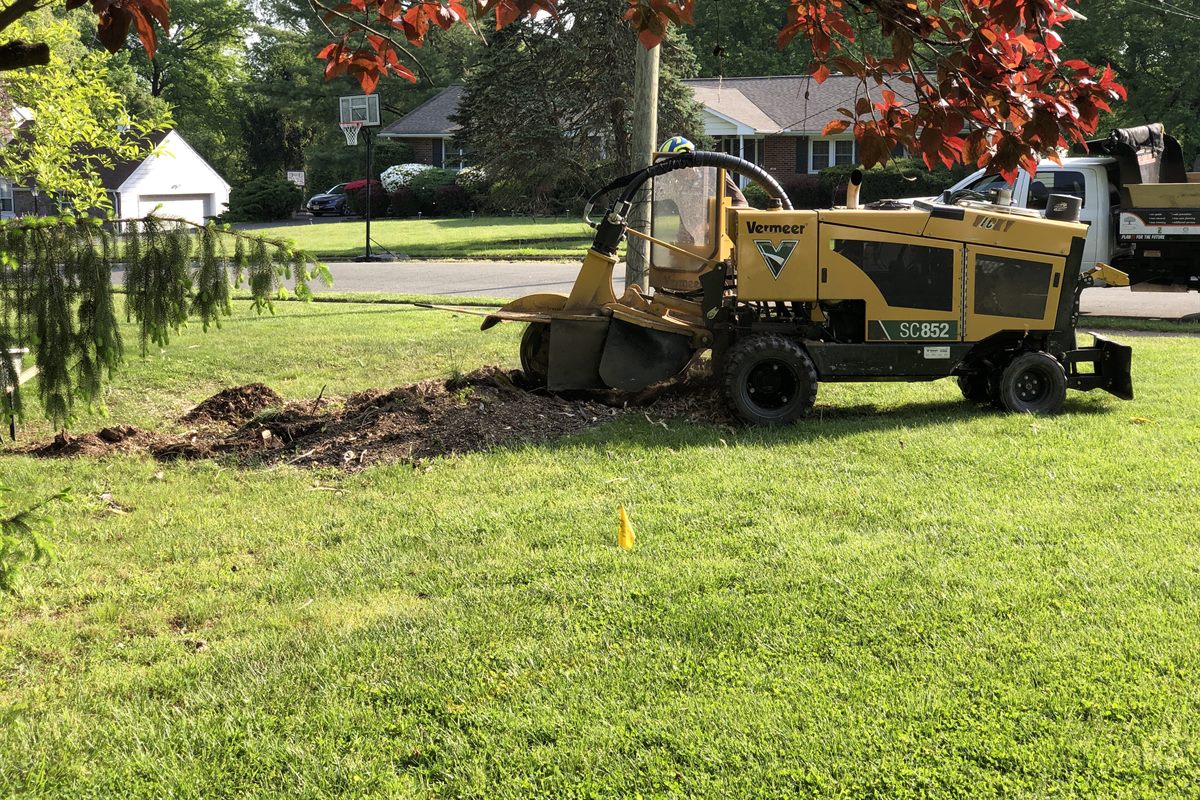
Grinding is fast because the machine only has to deal with what it can reach. The cutting wheel works across the stump in passes, chewing the wood and the soil around the flare into a mix of chips and dirt, and it stops at whatever depth you agreed.
What it does well: it gets the trip hazard and the mower obstacle out of your life, it opens the spot for turf, and it does it without an excavator crossing your lawn. On a standard yard it is the whole answer.
What it does not do: it does not take the roots. The laterals stay where they are and decay over years, which is normal rather than a job half finished. It also does not give you clean ground to build on, because there is still a root plate under the dish.
One thing worth knowing: grinding actually removes the buried stump wood that termites feed on, which is a point in its favour rather than against it. The mound it leaves is a separate question, and the options are in what to do with stump grindings.
When Do You Actually Need Full Stump Removal?
When something is going into or onto that ground that cannot share space with a root plate. That is a short list, and if your job is not on it, grinding is the better buy.
- A footing, slab or pier. Anything structural wants soil that will not settle when the wood under it finally goes.
- A trench or a line. Utility runs, irrigation mains, drainage and french drains have to cut through where the roots are.
- A pool, a retaining wall or a regrade. All three involve moving enough soil that the plate is in the way regardless.
- A driveway or a patio over the spot. Hardscape telegraphs settlement, and settlement is exactly what decaying roots produce.
- Severe root damage to hardscape you are replacing. If the roots lifted the old walk, leaving them lifts the new one.
Planting a replacement tree is not on that list, though it does want a deeper and wider grind than a lawn does. We cover the difference in can you plant a tree where a stump was.
One honest note about who does what. Full extraction is excavation work, with a machine, spoil to haul and ground to put back afterwards. On most residential lots it lands with a grading or excavation contractor rather than a tree crew, and often as part of a bigger project that was already moving dirt. We grind stumps; if what you need is the whole plate out for a footing, we will tell you that rather than sell you a grind that does not do the job.
What Does Each One Cost?
Grinding is priced per stump and the bands are published: $100 to $400 for most single stumps, or roughly $3 to $6 per inch of diameter measured across the widest point including the root flare. A grinder coming out on its own carries a trip minimum of $100 to $150, which is why booking the stump with the takedown is nearly always cheaper than calling back.
| Line | What it runs |
|---|---|
| Stump grinding, per stump | $100 to $400 |
| Stump grinding, per inch of diameter | $3 to $6 |
| Trip minimum if the grinder comes alone | $100 to $150 |
| Hauling the grindings away | adds $50 to $150 |
| Full extraction with a machine | Quoted per job, and the more expensive of the two |
We do not publish a band for full extraction, because there is not an honest one to publish. It depends on the machine, the access, how far the spoil travels and what the ground looks like when the bucket stops. Ask for it in writing, itemised, before anyone digs.
For context on the rest of the job, a small tree removal under 30 feet runs $300 to $800 in this market, and the full ladder of sizes is on the Garner cost page.
Pro tip: decide the method before the tree comes down, not after. While the crew, the chipper and the grinder are already in your Garner driveway you are paying one mobilisation. Ring back in November and you are paying the trip minimum again for a machine that could have rolled off the trailer in September.
Which One Should You Pick?
Work down this list and stop at the first line that describes your yard.
- Building, trenching, paving or regrading over the spot? Full extraction, and get it quoted with the rest of the groundwork.
- Putting a new tree in the same hole? Grinding, but deeper and wider than standard, with the grindings taken out.
- Want grass there? Grinding, then cap the dish with 4 to 6 inches of topsoil before you seed.
- Just want the mower to stop hitting it? Grinding, standard depth, and leave the mound or pay the haul-off.
- Several stumps across the property? Grinding, all in one visit, because the trip minimum is charged once.
- Stump in a bed, no plans for the spot? Grinding, or in some cases leave it; a stump out of the mower’s way is not urgent.
Frequently Asked Questions
Is stump grinding cheaper than stump removal?
Yes, usually by a wide margin. Grinding is a single machine and often under an hour, at $100 to $400 per stump, while full extraction brings an excavator, a spoil pile and lawn repair with it. That cost gap is why grinding is the default for residential work in Knightdale, Garner and South Raleigh.
Will the leftover roots regrow into a tree?
Grinding kills most species outright. A few sucker from the roots, Bradford pear and crape myrtle among them, and those shoots exhaust themselves in a season or two if you keep cutting them. Oaks and pines, which make up most removals here, almost never come back.
Do the roots left behind cause problems?
Rarely for a lawn. They decay slowly and hold soil while they do it, which helps on a slope or near a ditch, and the main visible effect is mild settling over the old root runs that you top-dress once or twice. For hardscape or a footing, that same settling is the reason to dig instead.
Can a grinder go deep enough to count as removal?
It can go deeper than standard, often to 18 inches or more for a replanting, but that is still grinding: the lateral roots stay. No grind, at any depth, gives you the clean excavated ground a footing wants.
How long does each method take?
A single stump is frequently ground in under an hour once the machine is in position, and a yard full of them is usually a morning. Excavation is most of a day by the time the hole is backfilled and the lawn is put back, plus whatever the machine does to the route in.
What happens to the hole afterwards?
After grinding you get a shallow dish you can fill with the grindings or with topsoil, depending on what is going there. After excavation you get a real hole that needs proper backfill, compacted in layers, or it sinks. Either way, ask who is filling it before you sign, in Wendell or anywhere else.
Grinding Stumps in Garner, Knightdale and Wendell
Tell us what is going on the spot and the method sorts itself out. We grind stumps at published per-stump bands and quote the haul-off as its own line, alongside tree removal and large and technical removals across Garner, Knightdale, Wendell and South Raleigh. If your project actually needs the plate excavated, we will say so.
You get an up-front written price before any work starts. Request a free written quote for stump grinding or call (919) 322-8083 during business hours.