Trees Near Power Lines in Johnston County
Garner Tree Removal • September 27, 2026 • 9 min read
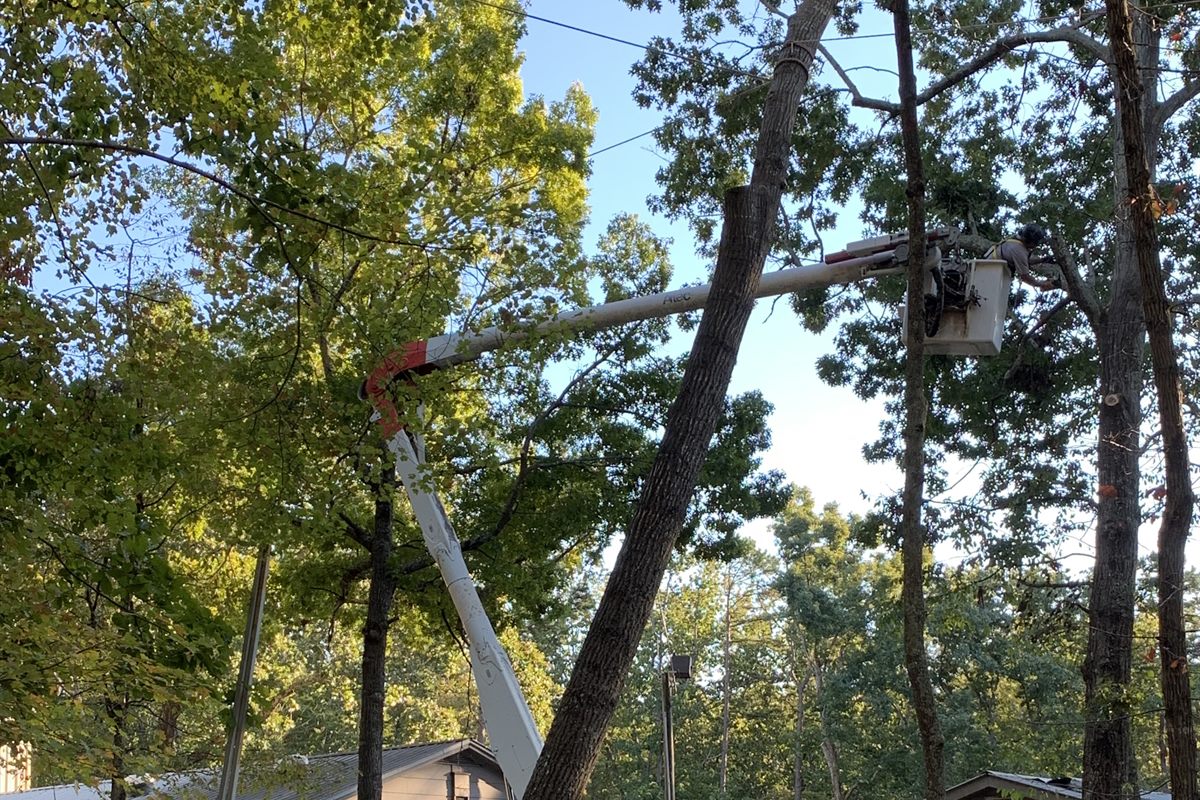
A limb off the oak in your side yard is resting on a power line, and if that tree is anywhere in Johnston County, the first question is not what it costs. It is who you call, and Johnston County does not have one answer. Smithfield, Selma, Benson and Clayton each run their own electric system and have since the 1910s, and the rest of the county, including Four Oaks, Archer Lodge and the unincorporated stretches between them, is split between Duke Energy Progress and one or more electric cooperatives.
This guide sorts the providers town by town, what each one’s own page says about trimming near its lines, and what happens on your side of the wire once it is clear. Every dollar figure below is a planning range for this market, not a quote.
Who Trims a Tree Near a Power Line in Johnston County?
It depends on which utility owns the line, and in Johnston County that is not always Duke Energy. Four towns, Smithfield, Selma, Benson and Clayton, own and operate their own electric systems, a status called public power, so the town, not Duke Energy, is the first call about a tree near its lines. Everywhere else in the county, the provider is Duke Energy Progress or an electric cooperative, and the rules follow whichever one actually owns the pole.
| Town or area | Who supplies the power | Confirmed by |
|---|---|---|
| Smithfield | Town of Smithfield (public power, since 1912) | ElectriCities of North Carolina; Town of Smithfield |
| Selma | Town of Selma (public power, since 1913) | ElectriCities of North Carolina; Town of Selma Electric Department |
| Benson | Town of Benson (public power, since 1913) | ElectriCities of North Carolina; Town of Benson |
| Clayton | Clayton Public Power (since 1913) | ElectriCities of North Carolina; Town of Clayton |
| Archer Lodge | Duke Energy | Town of Archer Lodge |
| Four Oaks | Not confirmed from an official source | See below |
| Unincorporated county | Duke Energy Progress or an electric cooperative, including South River EMC, depending on the parcel | Johnston County Economic Development; South River EMC |
All four public power towns are members of ElectriCities of North Carolina, and their systems date to 1912 or 1913. Inside these four town limits, the power company is the town, not Duke Energy.
Smithfield, Selma and Benson: Public Power Since the 1910s
Smithfield’s electric system dates to 1912, and Selma’s and Benson’s to 1913; all three are ElectriCities members. Selma’s own electric department page is the most specific of the three: “Never trim tree limbs that are on power lines. Call us first!” Tree trimming and removal near its lines is a service the department itself performs, and it takes requests at (919) 965-8981 or Electric-Department@Selma-NC.com.
Smithfield and Benson confirm the same public-power status on their own utility pages, but neither publishes a tree-trimming policy online. That does not mean there is not one; it means this article cannot state the details because no official source spells them out. If a tree in Smithfield or Benson is close to the line, call the town’s own department: Smithfield’s Electric Distribution division is at 919-934-2230, and Benson’s utilities office is (919) 894-3553, extension 220.
Pro tip: If you live in Clayton, Smithfield, Selma or Benson, do not assume Duke Energy handles a limb near your line just because Duke serves other nearby areas. These four towns run their own systems, and the number on your electric bill, not Duke’s, is the one to call.
Clayton Public Power: Contracted Crews and Directional Pruning
Clayton publishes the most detailed tree-trimming FAQ of the four public power towns. Clayton Public Power, on the ElectriCities roster since 1913, says it “contracts with professional tree trimming companies” whose technicians use directional pruning: “entire limbs or portions of limbs growing toward the lines are removed at the main branch or trunk,” rather than a flat face sheared into the canopy.
Clayton’s FAQ states that “utility representatives or contractors may enter property to trim any branches that are touching or are close to power lines.” It also draws a hard line on doing that work yourself: an unqualified person should not work within 10 feet of an overhead energized conductor carrying less than 50,000 volts, and the town’s page notes plainly that serious injuries and fatalities have occurred when unqualified people attempt it. If a tree in Clayton is growing toward a line, the town asks residents to call 919-553-1530 rather than get out a pole saw. Clayton is also part of this site’s Clayton service area for the tree work that comes after.
Who Serves Four Oaks, Archer Lodge and the Rest of the County?
Duke Energy provides electricity in Archer Lodge, according to the town’s own utilities page. Duke’s pole-to-meter boundary and its rule that only qualified line-clearance crews should work near an energized line are covered in full in what Duke Energy trims and what you own; that applies in Archer Lodge.
Four Oaks is a different story: this article cannot confirm its electric provider from an official source. Four Oaks does not appear on ElectriCities’ list of North Carolina public power communities, so it is not running its own system the way Smithfield, Selma, Benson and Clayton do, but no town, Duke Energy or cooperative page confirmed which provider actually serves it. The name on the electric bill is the fastest way to know who to call.
For the unincorporated county, Johnston County’s own economic development office says that in other areas of the county, electricity is provided by “Duke Energy Progress, the Electric Membership Corporation, and the South River Electric Membership Corporation.” The page does not say which cooperative the middle name means, so check the name on the bill. South River EMC’s service rules, filed with the North Carolina Utilities Commission, give the cooperative the right to cut and trim vegetation in its rights-of-way, and a member whose tree poses a possible hazard to a line can ask the cooperative to schedule the trimming. Those same rules set the point of delivery on an overhead service at the weather-head, the fitting where the utility’s wire ends and the homeowner’s wiring begins, which is the same boundary idea as Duke’s pole-to-meter line even though the two utilities have nothing to do with each other.
What Tree Work Costs Once the Line Is Clear
Once the utility, whichever one it is, has the line de-energized or already pruned back, the tree work on your side is priced the same as any other job: by size and access, not by the fact that a power line was nearby.
| Work | Typical 2026 range |
|---|---|
| Trimming and pruning | $300 to $1,500 |
| Small tree removal, under 30 ft | $300 to $800 |
| Medium tree removal, 30 to 60 ft | $500 to $1,500 |
| Large tree removal, 60 to 80 ft | $1,500 to $3,000 |
These are the same Garner-area price bands that apply across the service area, planning ranges rather than quotes. Whether a tree near a line should be pruned or removed is the utility’s call first and an arborist’s second; the quote prices the work once the line is clear. Either way, nobody should put a saw near a tree that is still touching an energized wire in any of these towns; that call goes to the utility first, not a tree crew.
Want the exact number for your tree? Request a free written quote for a written price on the work. For a full statewide breakdown of what drives removal pricing up or down, see the North Carolina tree removal cost guide.
Frequently Asked Questions
Does Duke Energy serve all of Johnston County?
No. Duke Energy serves Archer Lodge, and Duke Energy Progress or a cooperative serves other areas outside the four public power towns, but Smithfield, Selma, Benson and Clayton run their own electric systems and are not Duke customers inside town limits. Check the name on your electric bill before calling anyone.
Will the town trim a tree on my property for free?
None of the four towns publishes a price or a no-charge policy that this guide could confirm. Clayton’s FAQ says its contractors may enter property to trim branches touching or close to its lines, and Selma lists tree trimming and removal among its electric department’s services. Call the town’s electric department and ask directly.
What do I do if I live in unincorporated Johnston County?
Find the provider’s name on your electric bill; the county names Duke Energy Progress and electric cooperatives, including South River Electric Membership Corporation. South River EMC’s own service rules let a member ask the cooperative to trim a tree that threatens its line, scheduled at the cooperative’s convenience.
Can I trim the branch myself instead of waiting on the utility?
Not if it is touching or close to an energized line. Clayton’s own guidance says an unqualified person should stay at least 10 feet back from an overhead line carrying under 50,000 volts, and Selma’s electric department puts it just as plainly: call first. Smithfield and Benson publish no policy, so call them too. Once the utility has cleared the line, tree trimming and pruning on your side is ordinary work.
Who do I call about a tree near a line in Smithfield or Benson?
Smithfield’s Electric Distribution division is at 919-934-2230, and Benson’s utilities office is at (919) 894-3553, extension 220. Neither town publishes a detailed online trimming policy, so describe the tree and its location and ask what happens next.
What does it cost to remove the tree once the utility side is handled?
A typical removal in this service area runs $500 to $2,000, with small ornamentals as low as $300 and large or technical jobs running higher. Request a free written quote for the number specific to your tree.
Tree Work Near Power Lines Across Johnston County
Whoever trims the line, the tree work on your side of it is ours to quote. We price tree removal and tree trimming and pruning across Smithfield, Selma, Benson and Clayton with the same up-front written price used everywhere else in the service area.
Request a free written quote or call (919) 322-8083 during business hours. For a branch that is still touching a live wire, the first call is always the electric provider on your bill, not a tree company.
Sources: ElectriCities of North Carolina: Our Communities · Town of Selma: Electric Department · Town of Clayton: Electric FAQs · Town of Archer Lodge: Utilities · Johnston County Economic Development: Services & Utilities · South River EMC: Service Rules and Regulations