Who Is Responsible for a Fallen Tree in NC?
Garner Tree Removal • August 17, 2026 • 9 min read
The storm passed overnight, and this morning your neighbor’s water oak is lying across your fence, or maybe your loblolly pine is in their yard. Now comes the awkward part: two households, one downed tree, and everybody quietly wondering who pays. It is one of the most common disputes in the Garner and east Raleigh area every storm season, and most of the arguments start from an assumption about the law that turns out to be backwards.
One line before we start: this is general information about how these situations usually play out in North Carolina, not legal advice, and a genuinely contested dispute belongs with an attorney. Cleanup prices below are planning ranges, not quotes.
Who Is Responsible When a Tree Falls in NC?
In most North Carolina storm cases, responsibility follows where the tree lands, not whose yard it grew in. If a storm drops your neighbor’s healthy tree onto your property, the cleanup is generally your problem, handled by you or your own homeowners insurance if a structure was hit. It feels unfair the first time you hear it, but the logic is simple: when a healthy tree falls in a storm, the law generally treats it as an act of God that nobody caused, so each owner deals with what ends up on their own land.
The reason it works that way is worth knowing, because it tells you what to do. North Carolina does not apply strict liability to falling trees; it applies the ordinary common law negligence standard. A healthy tree that comes down in a storm is treated as an act of nature, and the damaged party’s own policy is the primary coverage.
The exception is negligence, and it turns on one legal term: actual or constructive notice. Where the tree was decayed, diseased, dead or otherwise in a dangerous condition beforehand, the owner may be liable for failing to remove or secure it. But with no actual or constructive knowledge of the defect, the owner is not responsible. So the question is never really “was the tree dead”, it is “could the owner be shown to have known”.
That is why putting it in writing matters so much. Where a neighbour has complained that a tree could fall, the owner is likely obliged to inspect within a reasonable period to determine the risk. A dated text message naming the tree and what you are seeing is how constructive notice gets created, and it costs nothing. If the tree was visibly dead, dying, or hazardous, and the owner knew about it, then the owner may be responsible for the damage it causes. A healthy tree plus a storm is nobody’s fault; a long-dead snag that the owner ignored after warnings is a different conversation, and often one between two insurance companies.
Here is how the common scenarios usually shake out:
| Scenario | Who usually handles it |
|---|---|
| Storm drops healthy tree on your house | Your homeowners insurance, minus deductible |
| Neighbor’s healthy tree falls in your yard, nothing hit | You (often out of pocket) |
| Neighbor’s known-dead tree falls on your property | Potentially the neighbor or their insurance |
| Tree falls across a shared property line | Each side typically clears their own side |
| Your tree falls into the street | The town or NCDOT usually clears the roadway |
Whoever ends up paying, the removal itself is ordinary work. Request a free written quote and you have a number to put in front of an insurer or a neighbour, which is a stronger position than an estimate over the phone.
Tree on Your House: Start With Your Own Policy
When a tree hits your roof, garage, or other covered structure, the standard path is a claim on your own homeowners policy, regardless of whose tree it was. The policy typically covers repairing the structure and removing the tree from it, minus your deductible. Photograph everything before any cutting starts, call your insurer early, and get the property safe; our emergency tree removal cost guide walks through the first-hour steps and what emergency tree removal runs when a structure is involved.
If the fallen tree belonged to a neighbor and you believe it was a known hazard, tell your insurance company that. Insurers can pursue the neighbor’s carrier themselves (the process is called subrogation), and if they recover, you may even get your deductible back. That fight is theirs to have, not yours to have over the fence.
Neighbor’s Tree on Your Fence or Shed
Fences and sheds follow the same pattern as houses: your property, your policy. The wrinkle is that fence damage often lands near or below the deductible. A grounded tree with a section of flattened fence might mean $300 to $1,200 of tree cleanup plus a few hundred in fence repair, and filing a claim for that total may not be worth it. Many neighbors in Knightdale and Clayton simply split a cleanup bill and keep both insurers out of it, which is often the cheapest and friendliest outcome.
If the tree was healthy, you have little leverage to demand the neighbor pay, so a voluntary split is a favor, not a debt. If the tree was an obvious hazard they had been warned about, raise it calmly and in writing before escalating.
A Tree Across the Shared Line
When a trunk lies across the boundary itself, the practical convention is that each owner clears the portion on their own side, and plenty of neighbors just hire one crew and split the invoice, which is cheaper than two separate mobilizations. Boundary-line trees (trees whose trunks grow on the line) are jointly owned in general terms, which also means neither neighbor should remove a living boundary tree without the other’s agreement. If a boundary tree is the subject of real disagreement, that is attorney territory, not tree-crew territory.
Documenting a Hazard Tree Before It Falls
The negligence exception only works if you can prove the owner knew. If your neighbor has a dead pine leaning your way, or a big water oak shedding limbs and growing shelf fungus at the base (a common sight in older Triangle neighborhoods, where many water oaks are hitting the 60-to-80-year age where they decline), build the paper trail now:
- Photograph the tree from your property, dated, showing the dead wood, fungus, lean, or cavity.
- Send a dated letter or email to the owner describing the concern and asking them to address it. Polite and factual beats threatening. Keep a copy; certified mail is the belt-and-suspenders option.
- Consider an arborist’s written opinion. A professional assessment stating the tree is hazardous is strong evidence that the risk was real and known.
- Repeat periodically if nothing changes. One letter from years ago is weaker than a recent record.
Two things happen with that letter. Most owners quietly get the tree handled, because their insurance agent will tell them a documented hazard is now their liability. And if the worst happens anyway, you have transformed “act of God” into a negligence question with evidence behind it.
If you are the owner receiving such a letter, take it seriously: a proactive removal at normal tree removal rates ($500 to $2,000 for a typical tree, more for large or technical jobs; see our full tree removal cost guide) is dramatically cheaper than owning the damage after a documented warning.
Insurance Claim or Just Pay for Cleanup?
Not every fallen tree is worth a claim. The rough decision framework:
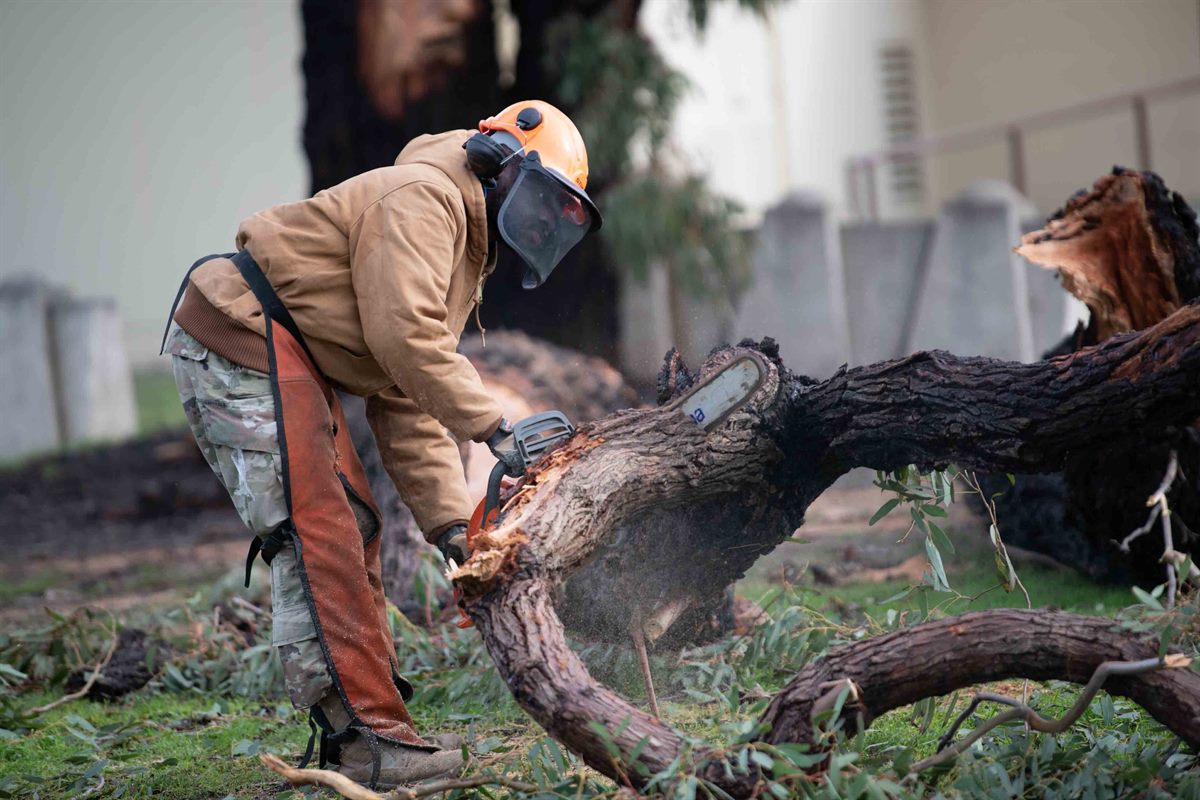
- Nothing was hit. Most policies pay little or nothing for a tree that fell harmlessly, so this is usually an out-of-pocket cleanup. A grounded tree typically runs $300 to $1,200 to cut up and haul in the Garner, Wendell, and Zebulon area, and our fallen tree removal cost guide breaks that range down.
- Minor structure damage. If cleanup plus repair is close to your deductible, paying cash avoids a claim on your record for little benefit.
- Real structure damage. Tree on the roof, crushed porch, water coming in: this is what the policy is for. Claim it.
Whatever you choose, get the tree work invoiced in writing. If damage turns out worse than it looked (roof damage often does), documentation lets you claim later.
Trimming Your Neighbor’s Branches at the Line
The flip side of the falling-tree question is the everyday one: their tree’s limbs are over your yard. The general North Carolina rule is that you may trim branches and roots that cross onto your property, up to the property line, at your own expense. What you may not do is cross the line, cut down the tree itself, or trim so aggressively that you kill or destabilize it; destroying a neighbor’s tree can create liability for its value, and mature hardwoods appraise surprisingly high. For anything bigger than pole-pruner work, especially limbs over structures, use a professional tree trimming crew and tell the neighbor first. A five-minute conversation prevents most of the disputes described in this article.
Frequently Asked Questions
My neighbor’s tree fell in my yard in a storm. Do they have to pay?
Usually not. A healthy tree felled by a storm is generally treated as an act of God in NC, so the cleanup falls to the property where it landed. The exception is a tree the owner knew was dead or hazardous before it fell.
Whose insurance covers a tree that fell on my house?
Yours, in the standard case. Your homeowners policy typically covers structure repair and removing the tree from the structure, minus your deductible, even if the tree grew next door. Your insurer can pursue the neighbor’s carrier if negligence was involved.
What does it cost to remove a fallen tree that did not hit anything?
Plan on roughly $300 to $1,200 for a grounded tree, depending on size and haul-away, and expect insurance to contribute little or nothing when no structure was damaged.
How do I protect myself from a neighbor’s dying tree?
Put them on notice. Photograph the tree and send a dated written letter describing the hazard, and consider an arborist’s assessment. Documented notice is what turns a future “act of God” into the owner’s responsibility.
Can I cut branches from my neighbor’s tree that hang over my yard?
Generally yes, up to the property line and at your own cost, but you cannot enter their property, remove the tree, or trim so severely that you kill it.
This article is general information, not legal advice; for a contested dispute or significant damages, consult a North Carolina attorney.
Storm Cleanup Without the Guesswork
Whether the tree is yours, your neighbor’s, or lying across the line, Garner Tree Removal serves Garner, South Raleigh, Knightdale, Clayton, Wendell, Zebulon, and Fuquay-Varina with written quotes, insurance-ready documentation, and honest advice about whether a claim is worth filing. Call (919) 322-8083 or request a quote online and we will help you sort out the tree first and the paperwork second.
Sources: NC Pro Bono Resource Center: Disaster Assistance Manual, Falling Trees, Flying Limbs and Loud Neighbors · Law Firm Carolinas: Liability for Fallen or Threatening to Fall Trees · Duke Energy: Rights of Way FAQ