Tree Trimming Cost in NC (2026)
Garner Tree Removal • September 10, 2026 • 9 min read
Trimming is the maintenance most people put off until a limb is scraping the roof or a storm takes one down for them. It is also the cheapest tree work you will ever buy, which is worth remembering: a $400 pruning visit every few years is considerably less painful than a $2,500 emergency removal after a limb splits.
This guide covers what tree trimming actually costs across North Carolina in 2026, what separates a $250 job from a $900 one, and which pruning is genuinely worth paying for. These are planning ranges for the NC market, not quotes. Trimming prices vary more than removal prices because “trim my tree” can mean six different jobs.
How Much Does Tree Trimming Cost in NC?
Most single-tree trimming jobs run $250 to $900 in 2026, with small ornamentals from about $150 and large hardwoods over structures reaching $1,000 to $1,800. Height is the main driver, because height determines whether the work happens from the ground, from a ladder, from a bucket truck, or from ropes.
| Tree size | Typical trimming cost (2026) | Common example around here |
|---|---|---|
| Small (under 25 ft) | $150 to $400 | A crepe myrtle or dogwood in a Garner front yard |
| Medium (25 to 50 ft) | $300 to $700 | A maple or river birch in a Clayton backyard |
| Large (50 to 75 ft) | $600 to $1,200 | A willow oak over a south Raleigh driveway |
| Extra large (over 75 ft, or over a structure) | $1,000 to $1,800+ | A water oak spanning a roofline in Knightdale |
| Multiple trees, same visit | 15 to 30 percent off each after the first | A row of pines along a property line |
The same bundling logic that applies to stumps applies here: getting a crew and a chipper to your address is a fixed cost, so trimming four trees on one visit costs far less than four separate visits.
Trimming Cost by Job Type
Height sets the band, but what you are asking for sets where in the band you land. These are the jobs people actually mean when they say “trimming.”
| Job type | What it involves | Typical cost | Usually worth it? |
|---|---|---|---|
| Crown cleaning | Removing dead, diseased, and crossing limbs | $250 to $600 | Yes, the highest value per dollar |
| Crown raising | Lifting the lower canopy off a roof, driveway, or lawn | $300 to $700 | Yes, especially near structures |
| Crown thinning | Selectively reducing density for light and wind flow | $400 to $900 | Sometimes, and easy to overdo |
| Crown reduction | Shortening the overall height and spread at proper cuts | $600 to $1,500 | Only when done by a skilled crew |
| Deadwooding a large hardwood | Removing dead limbs from a mature oak canopy | $500 to $1,200 | Yes, this is a safety job |
| Storm damage cleanup pruning | Cutting back torn and hanging limbs | $400 to $1,200 | Urgent, see the caveat below |
| Utility line clearance | Pruning around a service drop | Often free from the utility | Call them first |
Two notes that save homeowners real money. Utility clearance near the main lines is usually the power company’s job, not yours: call them before you pay anyone to prune around the lines feeding your neighborhood. And storm damage pruning after hours or during a regional event prices at emergency rates; if the limb is not threatening anything, waiting for normal scheduling is cheaper. Our storm damage and emergency work page covers when waiting is not an option.
What Factors Change Tree Trimming Cost?
Height and how the crew reaches the canopy
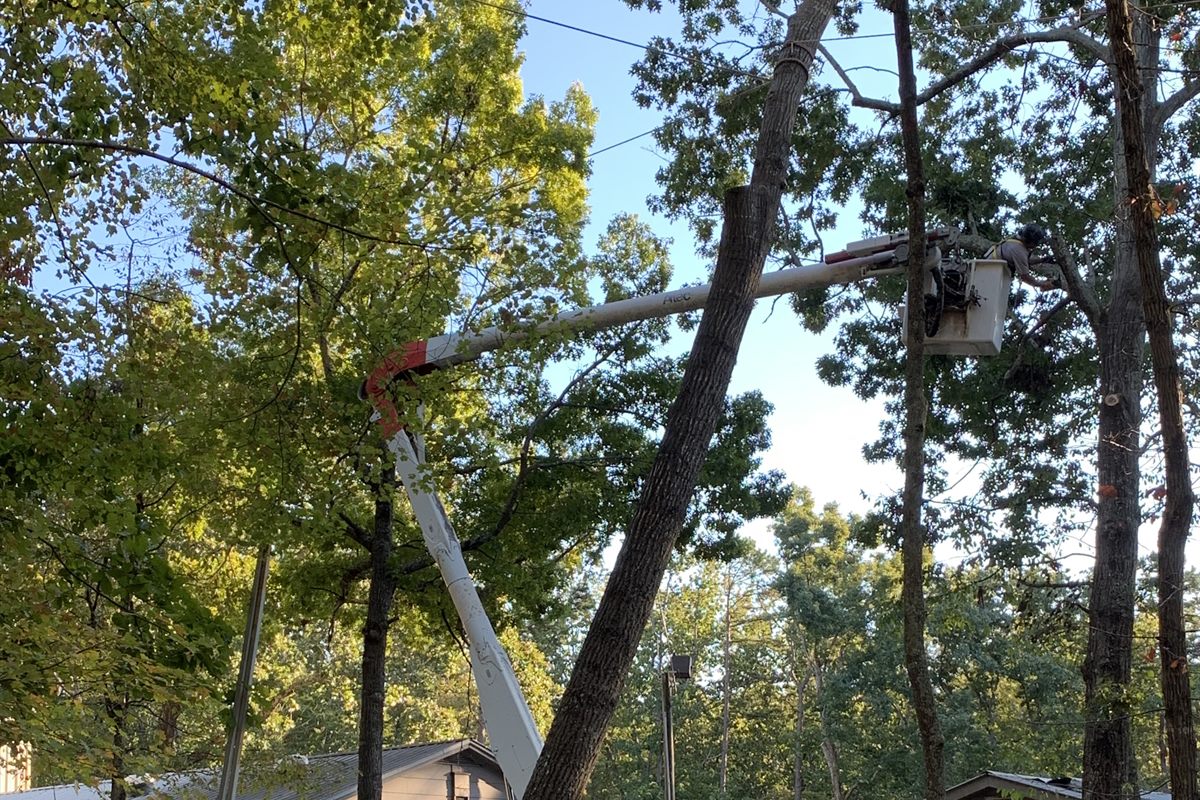
The single biggest cost jump is between work a crew can do from the ground or a bucket truck and work that requires a climber on ropes. If a bucket can park under the canopy, a medium oak might be a two-hour job. If the tree sits in a fenced backyard where the bucket cannot reach, the same tree becomes a climb, and the price can nearly double.
How much is coming off
A light cleanup of deadwood is a fraction of the cost of a full reduction. Volume of material drives chipping time and haul-off weight, which is a real share of the bill. When you get quotes, be specific about what you want removed rather than saying “clean it up,” because two estimators will interpret that very differently.
Proximity to the house and power drop
Limbs hanging over your roof or near the service drop to your meter cannot simply be dropped. Each piece gets roped and lowered. That rigging is slow, skilled work and is the main reason trimming over a structure costs roughly double trimming the same tree in an open yard.
Species and growth habit
Oaks compartmentalize pruning wounds well and tolerate proper cuts. Pines have limited response to pruning and generally should only have dead limbs removed. Crepe myrtles get butchered every winter across North Carolina in a practice that damages the tree and should cost you nothing because you should not do it. Species determines what work is appropriate, which determines the price.
Timing and season
Late winter dormancy, roughly January through early March in NC, is the best window for most hardwood pruning and often the easiest time to schedule. Demand spikes after storms and in late spring, and emergency calls carry premium rates. If your job is elective, booking in the dormant season can save 10 to 20 percent and is better for the tree.
Debris handling
Standard quotes include chipping brush and hauling it away. Leaving chips on site or bucking larger limbs into firewood lengths for you can reduce the price. Ask, because haul-off is a meaningful line item on a big job.
Trimming vs Removal: When Does Pruning Stop Making Sense?
There is a point where paying to maintain a tree stops being economical, and honest crews will tell you.
Trimming is usually the right call when the tree is structurally sound, less than about a third of the canopy is dead, and the problem is clearance rather than health. Removal usually wins when the trunk has significant decay or a major cavity, when more than half the canopy is dead, when the tree has a crack or lean that developed suddenly, or when roots have been severed by construction on two or more sides.
The uncomfortable middle case is a large, declining oak over a house. Deadwooding it every two years at $800 a visit can easily cost more across a decade than removing it once, and it does not eliminate the risk. Our guide on tree pruning vs removal works through that decision, and a tree risk assessment is the honest way to settle it before spending either way.
How Can You Save Money on Tree Trimming in NC?
- Bundle trees into one visit. The mobilization cost dominates small jobs.
- Book in the dormant season. January through early March is cheaper, easier to schedule, and healthier for most hardwoods.
- Ask for crown cleaning specifically. Removing deadwood delivers most of the safety benefit at the low end of the price range. You rarely need a full reduction.
- Call the utility before paying for line clearance. Pruning around primary distribution lines is generally their responsibility and generally free.
- Keep the chips. If you need mulch anyway, waiving haul-off trims the bill.
- Do not wait for a limb to fail. Scheduled pruning is ordinary work at ordinary rates. The same limb after it drops is emergency work, usually with property damage attached.
- Refuse topping. If a quote proposes cutting a mature tree back to stubs, get another quote. Topping is cheap, it permanently damages the tree, and it produces weak regrowth that costs you more within a few years.
What Should Be in a Tree Trimming Quote?
- Which specific trees, identified clearly, and what percentage of canopy is coming off
- The type of pruning: cleaning, raising, thinning, or reduction
- Whether the work follows ANSI A300 pruning standards, which is the professional benchmark
- How debris is handled, including whether logs are left
- Whether stump or limb wood is bucked for firewood
- Proof of liability and workers’ compensation insurance
- Confirmation that no topping or lion-tailing will be performed
That insurance point is not boilerplate. Climbers working over a roof is exactly the scenario where an uninsured crew becomes your financial problem.
Frequently Asked Questions
How much does it cost to trim a large oak in NC?
A mature willow oak or water oak in the 50 to 75 foot range typically runs $600 to $1,200 for a standard cleaning and raising. If the canopy spans a roofline and every limb has to be roped down, expect $1,000 to $1,800. Access is usually the deciding variable rather than the tree itself.
How often should trees be trimmed?
Mature hardwoods generally need attention every three to five years. Young trees benefit from structural pruning every two to three years, which is inexpensive and prevents expensive problems later. Fast-growing species near structures, and anything over a driveway, often need a look every two years.
Is tree trimming cheaper in winter?
Usually yes, by roughly 10 to 20 percent in the NC market. Dormant season demand is lower, leafless canopies are faster to assess and work, and it is the healthiest timing for most hardwoods. Storm season and late spring are the expensive windows.
Can I trim my own tree?
Anything you can reach safely from the ground with a pole saw is reasonable. Anything requiring a ladder near a roof or power drop is not. Ladder falls and chainsaw injuries during homeowner pruning are common, and a limb that swings the wrong way over your roof costs more than the job you were trying to save on.
Does trimming reduce storm damage?
Proper pruning genuinely helps. Removing deadwood, correcting crossing limbs, and reducing end-weight on long lateral branches lowers the chance of failure in wind. Topping does the opposite and creates weakly attached regrowth that fails more readily. The distinction matters.
Will trimming kill my tree?
Not when done correctly and in moderation. The general guideline is to remove no more than 25 percent of a mature canopy in a single season, and considerably less on a stressed tree. Over-thinning and topping are what damage trees, which is why a cheap quote proposing to take half the canopy is not a bargain.
Get a Tree Trimming Price for Your NC Property
Trimming quotes come down to how tall the tree is, whether a bucket truck can reach it, and how much you actually want removed. Most trees can be quoted closely over the phone with those three answers and a photo.
We handle tree trimming and pruning across Garner, south Raleigh, Clayton, Knightdale, and the surrounding east Wake towns. If you are weighing pruning against taking the tree out entirely, our tree removal cost guide has the other half of that comparison, and we will tell you honestly which one we think you need.
Call (919) 322-8083 or request a free quote and we will walk the tree with you before anything comes off.