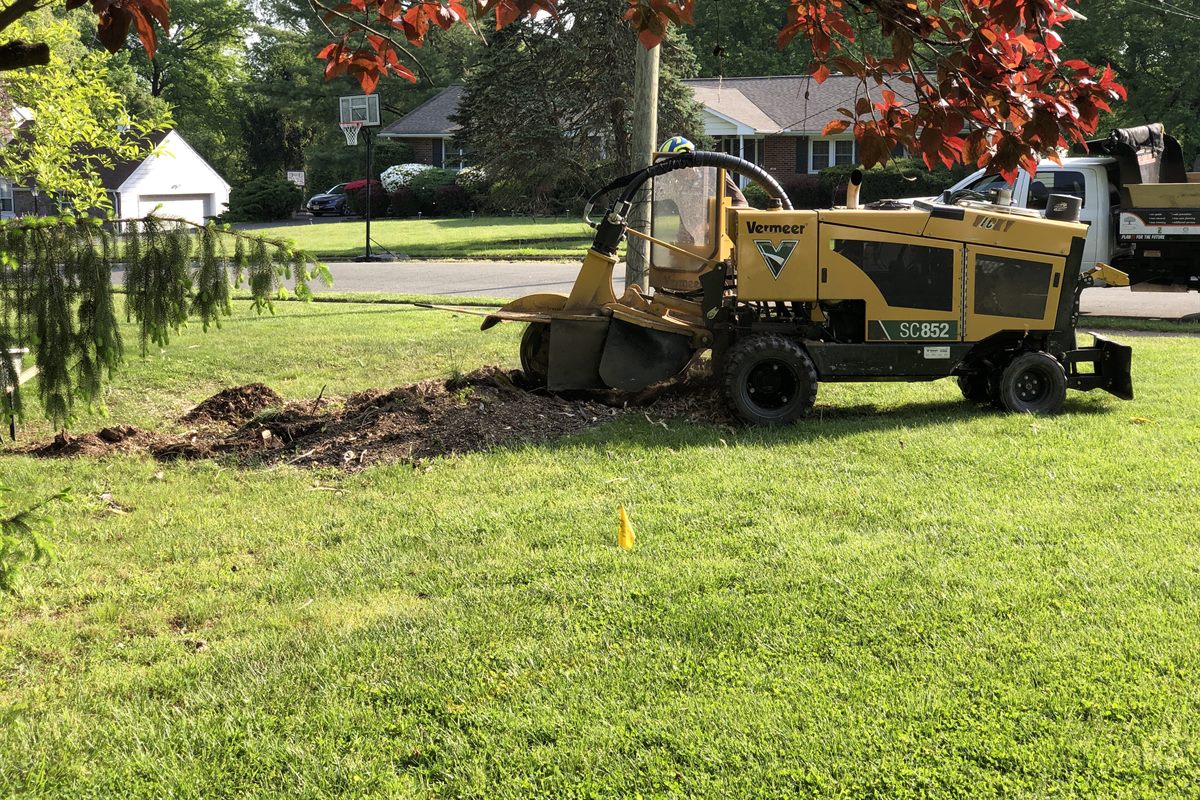
Who Owns a Tree on the Property Line in NC?
Garner Tree Removal • September 20, 2026 • 9 min read
There is a big water oak sitting almost exactly between two driveways. You have raked its leaves for eleven years. Your neighbor has never touched it. Now one of you wants it gone and the other does not, and the first thing anybody asks is whose tree it actually is.
The answer surprises most people, and it changes what either of you is allowed to do. In older Garner and east Raleigh subdivisions it comes up more often than you would think, because the trees went in before anybody worried about where a canopy would end up in fifty years.
This is general information, not legal or insurance advice; ask an attorney about your own boundary and your insurer about anything involving a claim.
Below: how ownership is decided, how to work out where the trunk really sits, what joint ownership lets each side do, how to split a removal, and what happens when a shared tree starts to decline. Prices are planning ranges, not quotes.
Who Owns a Tree on the Property Line in NC?
A tree whose trunk sits on the boundary is generally owned by both neighbors together, regardless of who planted it, who waters it or whose yard the canopy shades. It is called a boundary tree or a line tree, and joint ownership is the default treatment.
The detail that decides it is narrow: where the trunk stands at ground level. Not the canopy, not the roots, not the fence, not who has been picking up the acorns.
| Where the trunk sits | Who owns the tree | What that means |
|---|---|---|
| Entirely on your side of the line | You | Yours to keep or remove. The neighbor may cut back what overhangs their side |
| Entirely on their side | They | Theirs to keep or remove. You may cut back the overhang on your side |
| Straddling the line | Both of you, jointly | Neither side removes it alone. Trimming your own side is still allowed |
| Trunk on one side, roots crossing | The side the trunk is on | Crossing roots do not create shared ownership |
That is the whole rule, and nearly every boundary argument is really an argument about which row applies. Need the work priced either way? Request a free written quote and we walk the property, then put the scope and the number in writing.
How Do You Tell Where the Trunk Actually Sits?
You find the line, not the fence. Those are two different things far more often than homeowners expect, and a fence is the least reliable evidence in the whole question.
Fences get built inside the line on purpose, so the builder can reach both sides to maintain it. They get built by a previous owner who eyeballed it. They get replaced along the old post holes decades after the original posts drifted. None of that moves a property line, and none of it makes a tree jointly owned or solely owned.
What does settle it:
- The recorded plat and your deed. Wake County and Johnston County records show the lot dimensions and the bearings. That tells you where the line runs; it does not mark it on the ground.
- Survey pins. Iron pins at the lot corners are the physical record. In established neighborhoods they are usually still there, sometimes an inch or two under the turf, and a metal detector finds them.
- A licensed North Carolina surveyor. Where the tree is big, the relationship is tense, or the trunk is genuinely close to the line, a surveyor setting the line in writing is the only version that holds up later. That is their cost, quoted by them, and it is separate from any tree work.
- The trunk at grade. Measure where the trunk meets the soil, not where the flare spreads and not where the first branch leaves. A mature water oak can have two feet of root flare sitting on the far side of a line the trunk never crosses.
Pro tip: photograph the pins and a tape measure running from the pin to the trunk before any crew arrives, and do it with the neighbor present if you can. Once the tree is on the ground, nobody can prove where the trunk stood, and that single photograph has settled more Garner boundary disputes than any argument over the fence ever has.
What Joint Ownership Actually Means
Joint ownership sounds abstract until one of you wants the tree gone. In practice it lands in four places.
Neither owner removes it alone. A living boundary tree should not be cut down without the other owner’s agreement. Taking one out unilaterally can make you liable for the other owner’s share of its value, and mature hardwoods appraise higher than most people guess.
Either owner may still trim their own side. The self-help right to cut back to the property line does not disappear because the trunk is shared. You may cut what crosses onto your side, at your own expense, and you may not cut so hard that you kill the tree. The mechanics are the same as for cutting a neighbor’s overhanging branches.
Both of you carry the risk. If a shared tree is decaying and it fails, both owners are potentially in the frame, because both of them had the same opportunity to see the defect. That cuts against the instinct to stay quiet about a tree you half own.
Both of you can be on the paperwork. There is nothing stopping two owners hiring one crew, agreeing a split, and signing the same written scope. That is the cheapest way to handle it by a wide margin.
Splitting the Cost of a Boundary Tree
One crew and one mobilization costs less than two of anything, so a shared tree is usually cheaper to deal with than a tree either of you owned outright.
| Work | Typical 2026 range |
|---|---|
| Small tree removal, under 30 ft | $300 to $800 |
| Medium tree removal, 30 to 60 ft | $500 to $1,500 |
| Large tree removal, 60 to 80 ft | $1,500 to $3,000 |
| Technical, over-structure or crane-assisted | $2,500 to $6,000+ |
| Trimming and pruning | $300 to $1,500 |
| Stump grinding | $100 to $400 per stump |
Planning ranges for this market, not quotes. A boundary tree often prices toward the upper half of its size band, because dropping it in one piece is rarely an option with two houses, two fences and two sets of flower beds underneath. The Garner cost page and the tree removal cost guide break the size bands down further.
Before the crew books, get four things written down between the two of you:
- Who is hiring. One name on the work order, with the other owner named as consenting to the work.
- The split. Half and half is the usual starting point. A different split is fine if one side is getting the stump ground, the debris, or the firewood.
- What happens to the wood and the stump. Grinding is a separate line and a separate decision, and the stump of a boundary tree sits on both properties.
- Access. Which yard the truck parks in, what gets protected, and what happens if a gate panel has to come out to get equipment through.
When a Boundary Tree Is Dying or Dangerous
A shared tree in decline is the one situation where waiting costs both owners rather than one.
North Carolina applies the ordinary common law negligence standard to falling trees rather than strict liability, and liability turns on actual or constructive notice of the dangerous condition. On a boundary tree, both owners are standing in front of the same defect, which makes notice much harder for either of them to argue away. Our guide to who is responsible for a fallen tree in NC is the full explanation of how that standard works.
The practical read: if one owner raises a concern about a shared tree in writing, both of them are now on notice, and neither of them gets the act-of-nature answer if it comes down on a house. That is a reason to deal with it together rather than a reason to argue about whose half is rotten. The four checks that tell you whether a tree is dead or dying take about ten minutes and give you both something concrete to look at.
One more wrinkle worth knowing in the Knightdale and Wendell corridor: where a boundary runs through a Neuse riparian buffer, the buffer rule still applies to a shared tree. Removal of individual trees that are dead, diseased or damaged is deemed allowable under the Neuse rule, as is removal of individual trees in danger of causing damage to dwellings. The Division of Water Resources makes that call for a specific parcel, so ask before either of you books anything inside a buffer.
Frequently Asked Questions
Can my neighbor cut down a tree on the property line without asking me?
They should not. A boundary tree is generally jointly owned, and removing one without the co-owner’s agreement can expose the person who did it to the other owner’s share of the tree’s value. If it has already happened, photograph the stump and speak to an attorney before it is ground out.
Does the fence mark the property line?
Usually not exactly. Fences get set back, rebuilt on drifted post holes, or placed by eye, and none of that moves a recorded line. Find the survey pins, or have a licensed North Carolina surveyor mark it, before you rely on the fence for anything that matters.
Who pays to remove a shared tree?
Whatever the two owners agree, and half each is the common starting point. One crew on one work order is the cheaper route regardless, and a medium boundary tree of 30 to 60 feet typically runs $500 to $1,500 before any stump work.
What if the trunk is mostly on my side?
Then it is probably yours, but “mostly” is doing a lot of work in that sentence. Where the trunk touches the line at all, treat it as a boundary tree until a surveyor says otherwise, and have the conversation with the neighbor before you book tree removal in Clayton, Garner or anywhere else in the area.
Who owns the leaves, acorns and sap that land in my yard?
Practically, whatever falls on your side is yours to clean up, and North Carolina does not give you a claim against a neighbor for ordinary leaf and acorn drop from a healthy tree. Raking is not a legal grievance, however strongly October suggests otherwise.
Can I trim a boundary tree on my side without my neighbor’s permission?
Generally yes, back to the line and at your own cost, with the same limit that applies to any overhang: do not cut so far that you kill or destabilize the tree. For anything above pole-pruner height, use a trimming crew and tell the co-owner first.
Boundary Tree Removals in Garner and East Wake
Shared trees get easier the moment somebody puts the scope on paper. We quote removals, rigging between two houses and stump grinding across Garner, Knightdale, Wendell and Raleigh, with an up-front written price that both owners can read before anybody signs.
Request a free written quote or call (919) 322-8083 during business hours. Bring the neighbor out when we walk it, and you will both be looking at the same number.
Sources: NC Pro Bono Resource Center: Disaster Assistance Manual, Falling Trees, Flying Limbs and Loud Neighbors · Law Firm Carolinas: Liability for Fallen or Threatening to Fall Trees · 15A NCAC 02B .0714, Neuse riparian buffer rule