Tree Leaning Toward the House: When to Worry
Garner Tree Removal • September 15, 2026 • 10 min read
You noticed the pine out back is not standing straight, and now you cannot stop looking at it. Maybe it has leaned like that for twenty years and you only just registered it. Maybe it moved after the last storm. Those are two completely different situations, and telling them apart is most of what you need.
Around Garner and out through Wendell and Willow Spring this is a common worry for a good reason: the tall loblollies along property lines have all the leverage in the world, and the neighborhoods that filled in during the 1990s put houses close to trees that were already there. This guide covers what makes a lean dangerous, the signs that turn it urgent, and what the work costs if the answer is that it goes.
Every figure here is a planning range for this market, not a quote.
Is a Leaning Tree Dangerous?
A lean the tree grew into is usually stable; a lean that appeared or worsened recently is the one to act on. Trees lean for ordinary reasons, reaching for light at the edge of a canopy or bending away from a building, and they build reaction wood to hold the new shape. That kind of lean has been load-tested by every storm the tree has survived. A fresh lean has not.
Here is how the cases separate:
| What you are seeing | Read |
|---|---|
| Lean present for years, trunk flares evenly into the ground, no cracked soil | Usually stable. Worth monitoring, not panicking |
| Trunk curves upward toward vertical near the top | The tree corrected itself over years. A sign of a long-standing lean, not a new one |
| Lean appeared or increased after a storm | Treat as urgent until someone qualified looks at it |
| Soil heaved, cracked or mounded on the side opposite the lean | The root plate is lifting. This is the single worst sign on the list |
| Roots visible and lifting out of the ground on the high side | Same problem, further along |
| Trunk straight but the whole tree tilted, like a planted post pushed over | Root failure rather than a growth lean |
The pattern to internalise: trunk problems are usually slow, root plate problems are usually fast. A tree with a hollow trunk can stand for years. A tree whose root plate has started to lift is on a much shorter clock, and heavy rain followed by wind is the combination that finishes it.
Not sure which one you are looking at? Request a free written quote and we walk the property, then price whatever the tree actually needs.
The Signs That Turn a Lean Urgent
Four things move a lean from “keep an eye on it” to “deal with it now”.
It changed. Any recent increase in lean angle matters more than the angle itself, and it is the one sign that should not be monitored. A lean that has appeared or worsened recently needs a qualified assessment now, not a photo series, because the failure you are watching for can happen in the next wind. Photographing from a fixed spot and comparing over weeks is the right approach for a long-standing lean with undisturbed soil, and the wrong one for a new one.
The ground moved. Cracked, heaved or mounded soil on the uphill side means the root plate is rotating. Water gets into that crack, saturates the soil around the roots, and the next gust does the rest. This is why trees come down on calm-looking days after a wet week.
The roots are compromised. A trench cut for a driveway, a patio poured over the root zone, or grade changed against the trunk all cut anchoring capacity without touching the canopy. The tree looks fine and holds on badly.
The species is working against it. A leaning loblolly showing a browning crown and S-shaped galleries under the bark is hosting southern pine beetle, which goes primarily for trees already stressed and usually attacks trees at least 15 years old. A leaning water oak matters more than a leaning willow oak: NC State Extension puts water oak at 30 to 50 years and notes it can start breaking apart at maturity from rot, and the water oaks in the older Garner neighborhoods are at or past that age.
Pro tip: the question that matters is not “how far is it leaning” but “what is in the fall path”. A 70-foot pine leaning 10 degrees over open lawn is a different decision from the same tree leaning 5 degrees over a bedroom. Work that out from a distance of at least the tree’s full height, or from inside the house, or on a satellite view. Do not walk under a tree you are worried about to judge it, and keep people and vehicles out of the fall path until someone qualified has looked at it.
Who Decides, and Who Quotes
Worth being clear about the split. We are a removal and pruning outfit, not an arborist practice: we do not perform tree risk assessments or write risk reports. If you want a formal determination on whether a leaning tree is likely to fail, that is a certified arborist’s job, and you can find one through the International Society of Arboriculture’s directory or by asking the Wake County Cooperative Extension office who works locally.
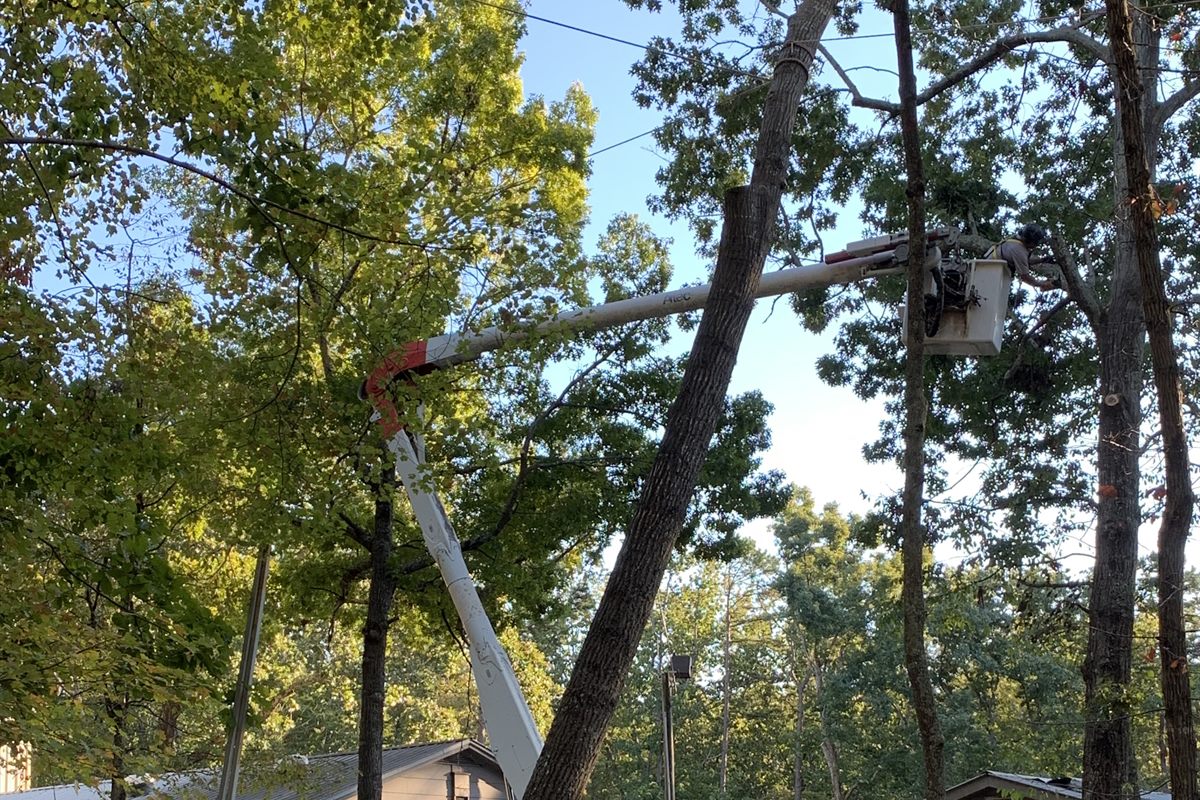
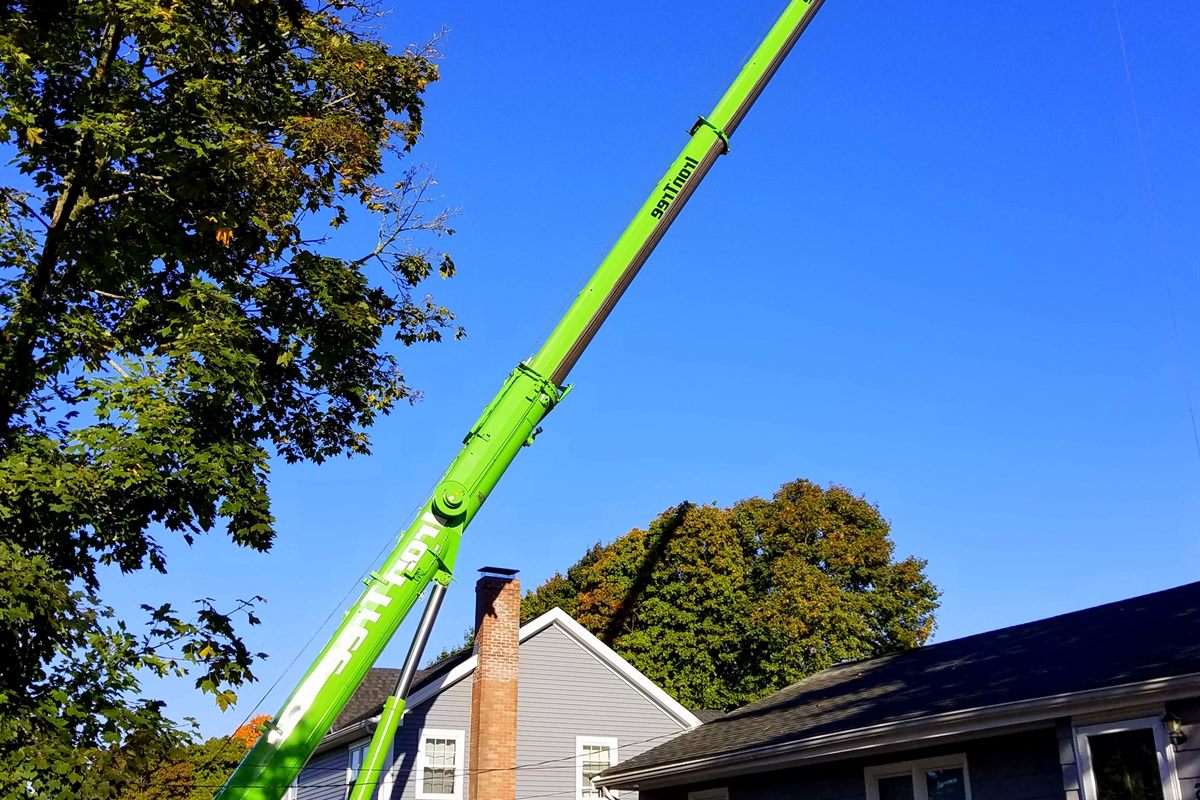
What we do is price the work once you know what it needs. Sometimes that is pruning to cut the wind load on a tree worth keeping. Sometimes it is removal. For a big tree over a roof it is rigging or crane work, which is a different job from dropping the same tree in an open field.
The Liability Part Nobody Mentions
If the leaning tree is your neighbour’s and it is aimed at your house, the law gives you a lever, and it depends on you using it.
North Carolina applies the ordinary negligence standard to falling trees rather than strict liability. A healthy tree that comes down in a storm is treated as an act of nature, and the damaged party’s own policy is the primary coverage. But where the tree was decayed, diseased, dead or otherwise dangerous beforehand, the owner may be liable in negligence for failing to remove or secure it, and liability turns on actual or constructive notice of that condition.
Which makes a written complaint the whole ballgame. Where a neighbour has complained that a tree could fall, the owner is likely obliged to inspect within a reasonable period to determine the risk. So: put it in writing, keep a copy, be specific about what you are seeing. A friendly text message that names the lean and the date does more for you than a year of worrying.
This is general information, not legal or insurance advice. Your insurer decides what your policy covers, and an attorney decides the rest.
Leaning Into a Power Line, or Standing in a Stream Buffer
Two special cases come up constantly here.
Power lines. The line running from the pole to your meter is your responsibility to keep clear, and Duke Energy will de-energize it at no cost on request before tree work starts. Lines running pole to pole down the street are Duke’s, and per North Carolina Utilities Commission rulings Duke may cut trees within 16 feet of its right-of-way that could fall and take out a transformer line, particularly dead or ailing ones. A tree touching an energized line right now is a call to Duke’s 24-hour emergency line, not to a tree company. The Duke Energy trimming guide has the full boundary.
Stream buffers. If the tree sits near a creek you may be inside the Neuse riparian buffer, which runs 50 feet from the water: the inner 30 feet is Zone 1 and the outer 20 is Zone 2. The rule is more accommodating than people expect about exactly this situation. Removal of individual trees in danger of causing damage to dwellings is deemed allowable, and so is removal of individual trees that are dead, diseased or damaged. What the rule protects is healthy vegetation in the inner zone. Requirements still vary by parcel, and the Division of Water Resources makes the determination on yours.
On permits generally: requirements vary by parcel, scope and jurisdiction, and the town office decides. Single-family lots are commonly exempt from tree protection rules, but commonly is not universally, so make the call.
What It Costs
| Work | Typical 2026 range |
|---|---|
| Clearance pruning to reduce wind load | $300 to $1,500 |
| Medium tree removal, 30 to 60 ft | $500 to $1,500 |
| Large tree removal, 60 to 80 ft | $1,500 to $3,000 |
| Technical, over-structure or crane-assisted | $2,500 to $6,000+ |
| Stump grinding | $100 to $400 per stump |
A leaning tree over open ground usually prices in its size band. A leaning tree over a roof does not, because the work becomes rigging rather than felling: sections come down on ropes instead of dropping. That is the difference between the large band and the technical one, and it is decided by method and access, not by how alarming the tree looks. Full breakdowns are on the Garner cost page and in the statewide cost guide.
Frequently Asked Questions
How much of a lean is too much?
There is no single angle that makes a tree unsafe, which is why arborists look at change and at the root plate instead of reaching for a protractor. A long-standing lean with even trunk flare and undisturbed soil can be fine at an angle that looks alarming; a fresh 5-degree lean with cracked soil behind it is not.
My tree started leaning after a storm. Is that an emergency?
Treat it as urgent, and understand what we can and cannot do. We do not run an after-hours crew, so a tree actively resting on the house or a line tonight is a call to a 24-hour tree service or to Duke Energy. A tree that has shifted but is stable and clear of structures is ordinary scheduled work at ordinary rates, which is also the cheaper outcome.
Can a leaning tree be straightened or cabled?
Cabling and bracing are real techniques, generally for young trees or for reducing the risk of a specific limb failure, and they do not fix a compromised root plate. An established tree leaning because its anchoring has failed is not a candidate. That determination belongs to an arborist, not to a quote.
Does the direction of the lean change the price?
Yes, more than the angle does. A tree leaning away from structures can often be felled in one piece, which is the cheapest version of the job. A tree leaning toward a roof, fence or driveway has to be dismantled in controlled sections, which takes longer and needs rigging.
Do you work in Clayton and Willow Spring?
Yes. Leaning-tree removals are ordinary planned work across Clayton, Willow Spring, Knightdale and Raleigh, as well as Garner itself.
Should I just wait and watch it?
Sometimes, and photograph it while you wait. A stable long-standing lean with nothing in the fall path is a reasonable thing to monitor. A lean that is over your house, that has changed recently, or that has soil movement behind it is not something watching improves.
Leaning Tree in Garner or East Wake?
If the signs above point toward acting, the next step is a written price rather than another opinion from the driveway. Leaning-tree work is routine for us across Garner and the east Raleigh belt. We quote removal, rigging work over structures and stump grinding across Garner, Knightdale, Clayton and Willow Spring.
Get a free written quote or call (919) 322-8083 during business hours, and you have an up-front price before anything starts. If the tree looks stable to us and you want a formal opinion anyway, get the arborist report; on a tree over a bedroom that is money well spent.
Sources: NC Extension Gardener Plant Toolbox: Quercus nigra · NC Forest Service: Southern Pine Beetle Prevention Program · NC Pro Bono Resource Center: Disaster Assistance Manual, Falling Trees · 15A NCAC 02B .0714, Neuse riparian buffer rule · Duke Energy: Distribution Line Vegetation Management · NC State Extension: Protecting and Retaining Trees