Hollow Tree: Does It Need to Be Removed?
Garner Tree Removal • September 20, 2026 • 9 min read
You found the hole. Maybe a limb tore out years ago and the wound never closed, maybe you finally pulled the ivy off the base. Now you can get your arm into the trunk of a tree you have parked under for a decade, and everyone who walks past has an opinion about it.
The answer is less alarming than it feels. A hollow tree is not the same as a weak tree. Around Garner and the east Raleigh belt there are willow oaks with cavities you could post a letter into that have stood through every storm since the neighbourhood was built, and solid-looking pines that came down in one gust.
This guide covers why hollow is survivable, the numbers arborists use, what turns a hollow tree into a removal, and what the work costs. Every figure here is a planning range for this market, not a quote.
Does a Hollow Tree Need to Be Removed?
Often not. A tree carries most of its strength in the outer wood, so a trunk still holding a sound shell of roughly a third of its radius is frequently stable, and hollow oaks stand for decades. What decides it is how much sound wood is left, how far the opening wraps round the stem, whether the tree leans, and what sits underneath.
The engineering is easier than it sounds. A tree stem behaves more like a scaffold pole than a solid post: in a round section the resistance to bending concentrates at the outside, and the material in the middle contributes least. Losing the middle costs far less strength than the size of the hole suggests. It is also the part the tree is most willing to give up, because heartwood is already dead tissue while the living cambium, the sapwood and the wood added each year all sit on the outside.
What the tree cannot do is put wood back. Trees do not heal wounds, they wall them off and grow around them, which is why the edges of an old cavity roll inward as new wood closes over the margin. That rolled edge is a good sign.
How Much Hollow Is Too Much?
Three numbers get used, and they broadly agree.
The one arborists work to is a ratio. Research published in Arboriculture & Urban Forestry puts the common working threshold at a t/R of about 0.3: where the thickness of remaining sound wood is at least 30% of the stem’s radius, the stem is unlikely to fail from that decay alone. The plain-English version comes from University of Maryland Extension, whose guidance is that if roughly a third of the interior is hollow or rotten the tree probably should be removed. The third figure covers the opening rather than the shell: a cavity taking up less than a third of the stem’s circumference is generally treated as having little effect, while damage to more than about 25% of the trunk’s circumference is a removal criterion of its own.
Here is the catch, and it is why this question is hard. None of those measurements can be read from the yard. You can see the opening; you cannot see where sound wood stops and punky wood starts behind it. That is what advanced inspection exists for, and it is covered in what a tree hazard evaluation involves.
| What you can see | What it suggests | What to do |
|---|---|---|
| A small opening, wound wood rolling in at the edges | The tree is walling the decay off and growing around it | Usually monitor |
| An opening you can reach into, firm wood all round | Hollow, shell probably sound | Get it measured before deciding |
| Soft, punky wood you can dig out with a finger | Active decay in the shell, not just the centre | Get it looked at soon |
| Shelf fungus on the trunk or buttress roots | A decay fungus already established inside | Get it looked at soon |
| The opening wraps more than a third of the way round | The shell is carrying the load on one side | Treat as urgent |
| Hollow plus a lean, or hollow plus heaved soil | Two defects stacking | Treat as urgent |
Already been told the tree goes? Request a free written quote and we walk the property, then price the takedown in writing before anything starts.
Why Hollow Trees Still Fail
When a hollow tree does come down, the hollow is rarely working alone. Four things stack on top of it.
Where the cavity sits. A hollow low on the trunk matters more than the same hollow twelve feet up, because the base carries the most bending load when the canopy catches wind.
What is happening below ground. The decay visible at the base often continues into the root flare and the structural roots, and that part nobody can see. A stem passing the shell test can still stand on a compromised root plate.
A bad union above it. Two stems meeting in a tight V with bark trapped in the seam will split under ice or wind load whether or not the trunk beneath is hollow. Add both and the tree has two ways to fail.
Exposure that changed. A tree that grew up inside a stand never built wood for open-field wind, and a heavy one-sided canopy turns every gust into leverage against the thinnest part of the shell. When the lot next door is cleared, the hollow tree left standing carries load it never has, which is what Garner’s canopy loss looks like in one yard.
Pro tip: do not fill the cavity. Concrete, spray foam and expanding filler were all popular once and none help: they add weight, hold moisture against the sound wood you are relying on, and hide the one thing anyone qualified needs to measure. A cavity is not a hole in a wall. Leave it open, keep the ivy off it, and photograph it each spring from the same spot with something for scale.
The Species Picture Around Garner
Hollow means different things depending on what is hollow.
Water oak is the classic hollow tree here, and a hollow one is following the script. NC State Extension puts the species at 30 to 50 years, calls it weaker-wooded than most oaks, and notes it can start breaking apart at maturity from rot. The water oaks planted when these neighbourhoods went in are at or past that age.
Willow oak is a longer conversation at about 80 to 90 years in urban conditions, so a hollow one in its sixties has more runway and is more often worth keeping with a reduction prune.
Loblolly pine rarely hollows out standing. Pines here get killed rather than rotted: loblolly and shortleaf are most susceptible to southern pine beetle, which usually attacks trees at least 15 years old and already stressed, and the tells are a browning crown and S-shaped galleries under the bark.
What It Costs, and the Cheaper Options First
| Work | Typical 2026 range |
|---|---|
| Crown reduction to cut wind load on a hollow tree | $300 to $1,500 |
| Medium tree removal, 30 to 60 ft | $500 to $1,500 |
| Large tree removal, 60 to 80 ft | $1,500 to $3,000 |
| Technical, over-structure or crane-assisted | $2,500 to $6,000+ |
| Stump grinding | $100 to $400 per stump |
The cheapest interventions come first. Reducing the sail area through crown reduction pruning lowers the load on a compromised shell and is often the recommendation on a hollow tree worth keeping. Doing nothing is a legitimate answer for a hollow tree over open lawn.
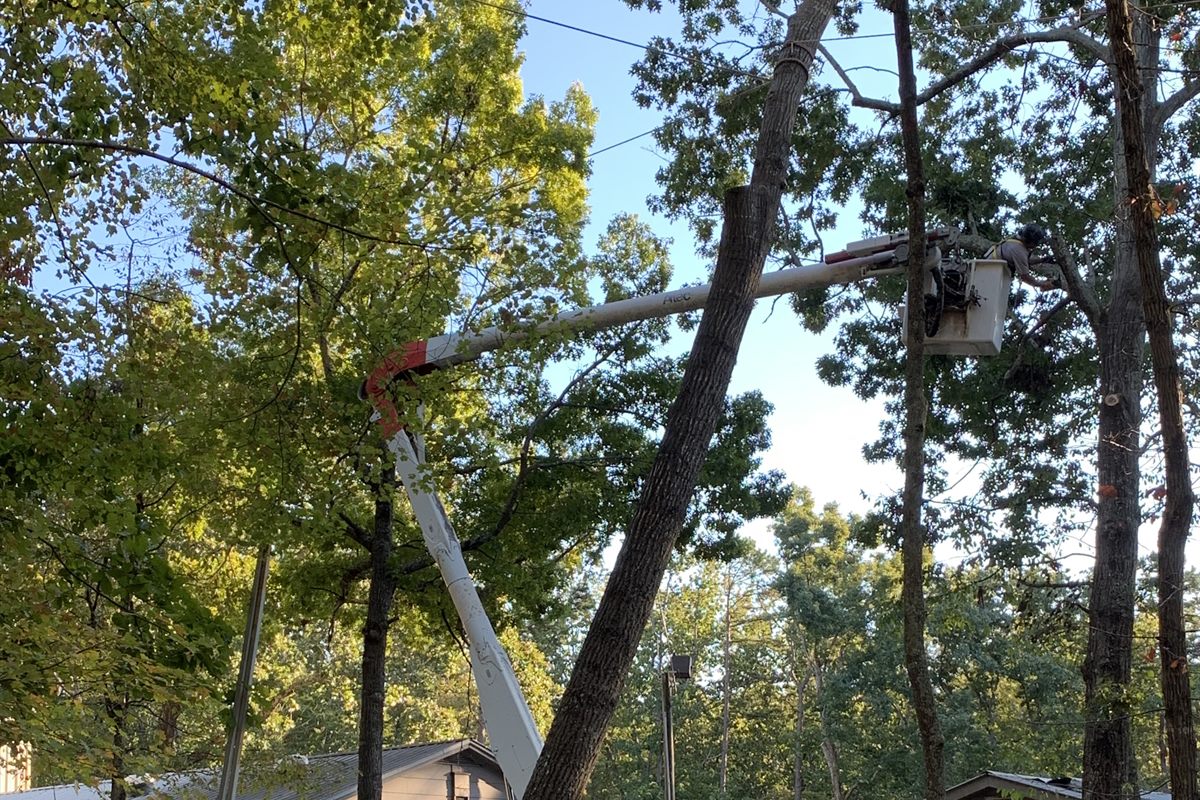
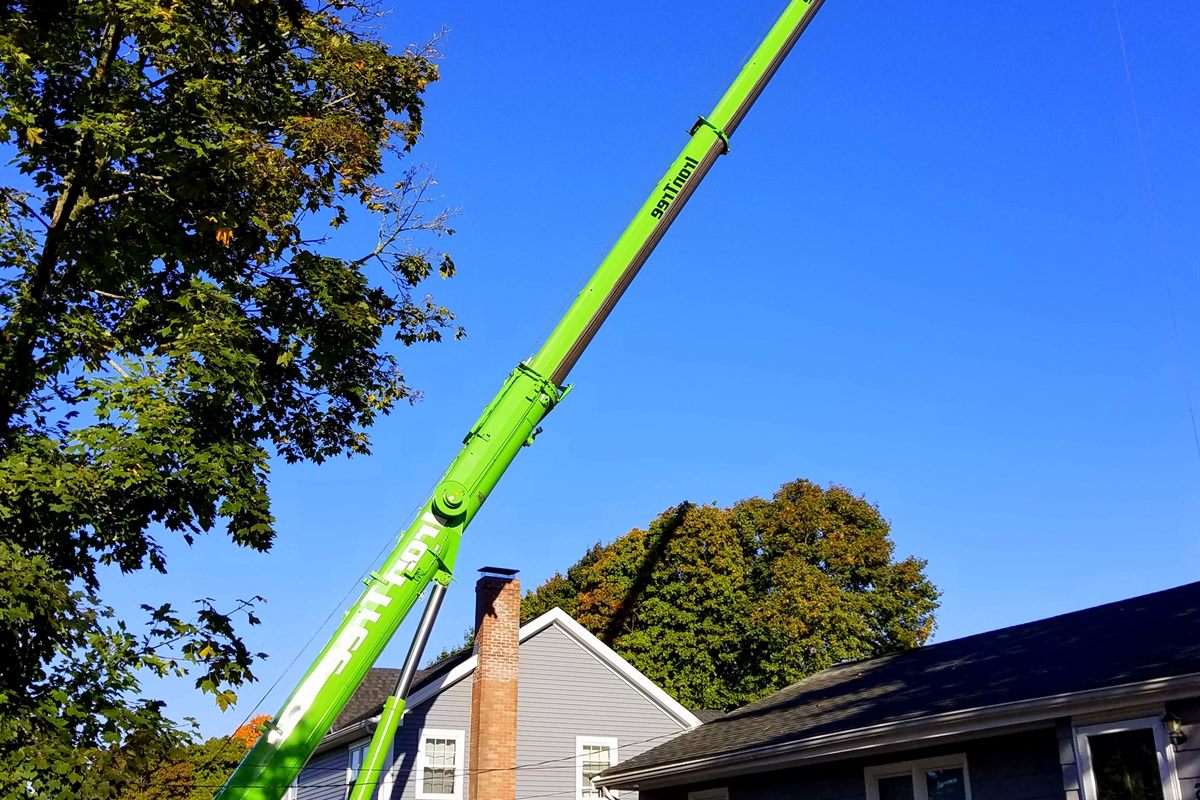
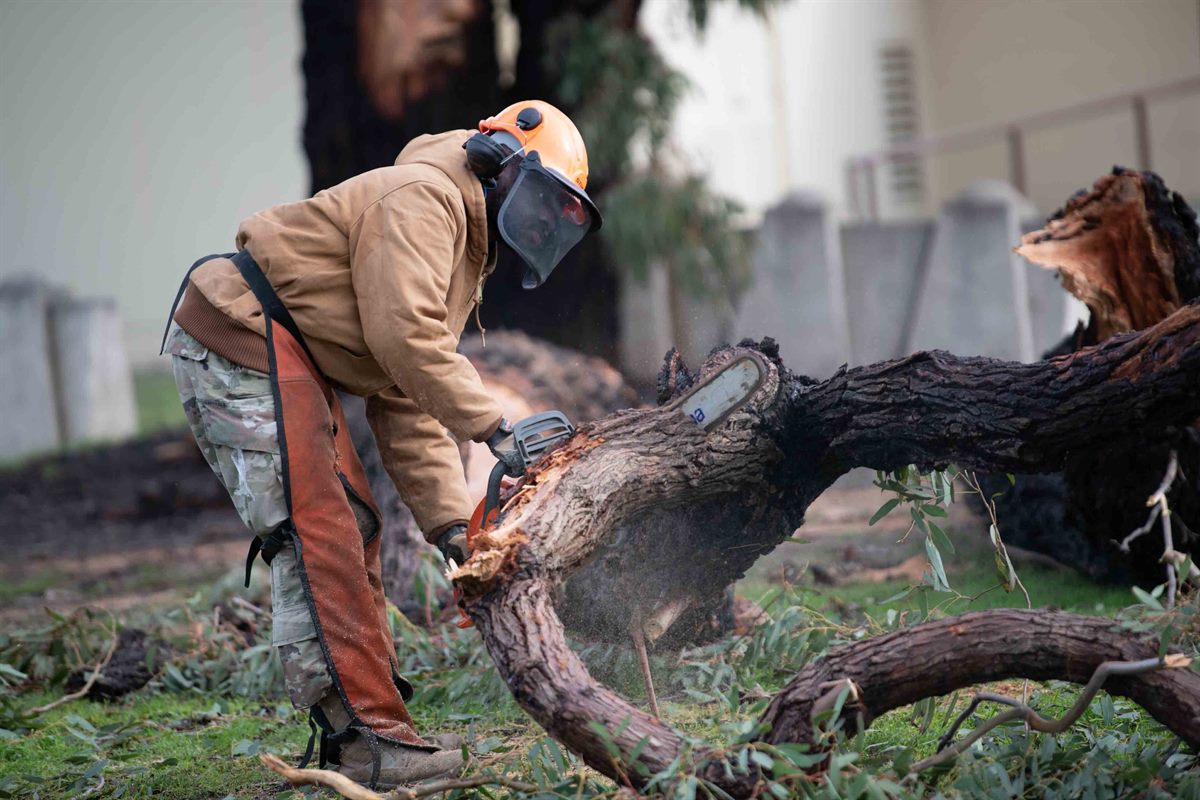
If removal is the answer, a hollow trunk makes the job harder rather than easier. A hollow stem cannot be relied on to hold a hinge when felled and is unpredictable to climb, so a hollow 60-footer near a roof is dismantled in sections on ropes as rigging work. Full breakdowns sit on the Garner cost page and in the statewide cost guide.
Frequently Asked Questions
Can a hollow tree heal or close back up?
Not in the sense people mean. Trees compartmentalise rather than heal: the decayed wood never comes back, but the tree walls it off and lays new wood around the margin, so an old cavity can slowly close at the edges. Edges rolling inward are doing better than edges that are flat and grey.
Should I fill the hollow with concrete or foam?
No. Filling adds weight the tree has to carry, traps moisture against the sound shell, and makes inspection impossible later, because an arborist cannot probe or drill what has been packed solid.
How can anyone tell how thick the sound wood is?
With tools, from the outside in. A mallet and a probe give a rough read; advanced assessment adds resistance drilling, sonic decay detection or root collar excavation. That work belongs to a certified arborist: find one through the International Society of Arboriculture’s directory or ask the Wake County Cooperative Extension office, then bring the report to us.
Is a hollow tree covered by insurance if it falls?
Policies generally respond to damage rather than risk, as set out in what insurance covers on tree removal. The part specific to a hollow tree is liability: North Carolina applies the ordinary negligence standard and it turns on actual or constructive notice of a dangerous condition, so a neighbour’s written complaint about your hollow oak changes your position. General information, not legal or insurance advice.
Does a hollow tree still need removing if it is nowhere near the house?
Usually not, and it is the part nobody selling removals volunteers. Risk is the tree plus what is underneath it, so a hollow tree over the back corner of a Clayton or Willow Spring lot can often be left standing, monitored, and enjoyed by the woodpeckers.
Do you take down hollow trees in Zebulon and Archer Lodge?
Yes. Hollow and decayed removals are planned work across Zebulon, Archer Lodge, Clayton and Willow Spring, as well as Garner itself.
Hollow Tree in Garner or East Wake?
If the shell is thin, the opening is wide or something valuable sits underneath, the next step is a written price rather than another opinion over the fence. We quote removal where the tree has to go, reduction pruning where cutting the wind load buys it years, and stump grinding afterwards, across Garner, Clayton, Zebulon and Willow Spring.
Request a free written quote or call (919) 322-8083 during business hours, and you get an up-front written price before any work starts. If the tree looks worth keeping, we will tell you that instead.
Sources: University of Maryland Extension: How Do You Decide When to Remove a Tree? · Arboriculture & Urban Forestry: Accuracy of Formulas Used to Assess Strength Loss Due to Decay · NC Extension Gardener Plant Toolbox: Quercus nigra · NC State Extension: Southern Pine Beetle