Bradford Pear Splitting: Why It Happens
Garner Tree Removal • September 20, 2026 • 8 min read
There is a particular sound a Bradford pear makes when it goes, and anyone who has lived on a street lined with them in Garner or Clayton has heard it. No warning, no lean, no dead branches the season before. One storm, and half the tree is lying across the front lawn with a pale wet scar running down the middle of the trunk where the two halves used to meet.
Bradford pear splitting is not bad luck and it is not a disease. It is the predictable result of how the tree is built, and once you know what to look for you can usually pick out which ones on your street are next. This guide covers why they split, how to read the union on your own tree, whether pruning is worth the money, and what North Carolina recommends planting in the gap. Any price here is a planning range, not a quote.
Why Do Bradford Pears Split?
Because they grow fast, and fast growth builds weak branch unions. NC State Extension’s publication on Callery pear puts it directly: the tree’s acute branching structure and fast growth lead to weak branch unions, and eventually the tree can break under its own weight.
The rest of the entry is just as blunt. NC State describes weak branching structure and brittle wood resulting in frequent breakage, and says that mild or moderate storms cause excessive branch and main stem breakage. Not severe storms. Mild ones.
That is why the failures around here cluster in two windows: thunderstorm season from June through September, and any winter week that puts ice on the canopy. A Bradford pear does not need a hurricane. It needs a gust that catches a crown shaped like an upturned umbrella, sitting on top of unions that were never properly joined in the first place.
The Shape That Causes It
Look at the trunk about four to six feet off the ground. On a healthy tree, branches leave the stem one at a time, spaced out, at a decent angle. On a Bradford pear, several stems leave from almost the same point at a steep upward angle, pressed against each other. Bark gets trapped between them as they thicken, and bark is not wood: the stems are wedging each other apart rather than growing together.
| What to look for | What it means | What to do about it |
|---|---|---|
| Three or more stems leaving the trunk at nearly one point | The classic Callery pear union, weak by design | Start planning the replacement |
| A narrow V union with bark pinched inside it | Included bark, so the stems are pushing apart | Treat as high risk in wind or ice |
| A fresh vertical crack at the union | The split has already begun | Stop parking or playing under it |
| Half the crown gone after a storm | One stem has failed and the rest is unbalanced | Usually a removal |
| Suckers from the base and root flare | Regrowth from below the graft | Cut them low, they revert to the rootstock |
| Thorny seedlings in the fence line | Callery pear spreading from your tree | Pull them while they are small |
That last row surprises people. Wild Callery pears growing from seed carry thorns up to four inches long, enough to injure livestock and wildlife and, as NC State notes, capable of popping tractor tires. The ornamental in your front yard does not have them; its offspring in the hedgerow do.
Seen a crack in a union and want the tree priced? Request a free written quote and we walk the property, then put the number in writing.
Can Pruning Save a Bradford Pear?
It can buy years, and it cannot change the architecture. Reducing the length and end weight of the longest stems lowers the leverage on the unions that fail, and taking out one of three competing stems while the tree is young genuinely improves the odds. On a young tree in a front yard in Fuquay-Varina, that is money well spent.
On a mature one it is a holding action. The unions are already formed, the included bark is already in there, and no amount of pruning knits two stems together after the fact. If the tree has already lost a stem, the remaining crown is lopsided and the wound is a decay entry point, which our guide on tree trunk rot signs covers.
Topping is worse than doing nothing. It produces a flush of weakly attached regrowth on a tree whose attachments are the whole problem, and the large cuts do not seal.
Pro tip: go and look at the union in February, with the leaves off. In full leaf you cannot see the branch architecture at all, which is exactly why nobody spots the problem until the tree is on the lawn. Winter is when a three-stem union with bark pinched in it is obvious from the driveway, and it is also the quieter half of the year to book the work.
What to Plant Instead, and the Program That Helps Pay for It
Bradford pears also have a second problem that has nothing to do with storms. NC State describes Callery pear as showing highly invasive traits, including aggressive proliferation and displacement of native species, with wild trees spreading into roadsides, fields, unmanaged lots, urban areas, wetlands and forests. The thorny seedlings along fence lines in Willow Spring and out past Clayton came from ornamental trees like the one in your yard.
NC State Extension suggests five native replacements: flowering dogwood, eastern redbud, serviceberry, black cherry and Chickasaw plum. The first three give you the same thing people wanted from a Bradford pear in the first place, which is a modest tree with spring flowers that fits under power lines.
There is also a program that pays part of the bill. The NC Bradford Pear Bounty, launched in 2022 as a joint effort of NC State Extension, the North Carolina Urban Forest Council, the North Carolina Wildlife Federation and the NC Forest Service, exchanges a free native tree for each Bradford or Callery pear a homeowner removes from their property, up to five trees. Events run around the state and the schedule is published by NC State Extension. Check whether one is running near Wake County before you book your removal; the timing is worth an email.
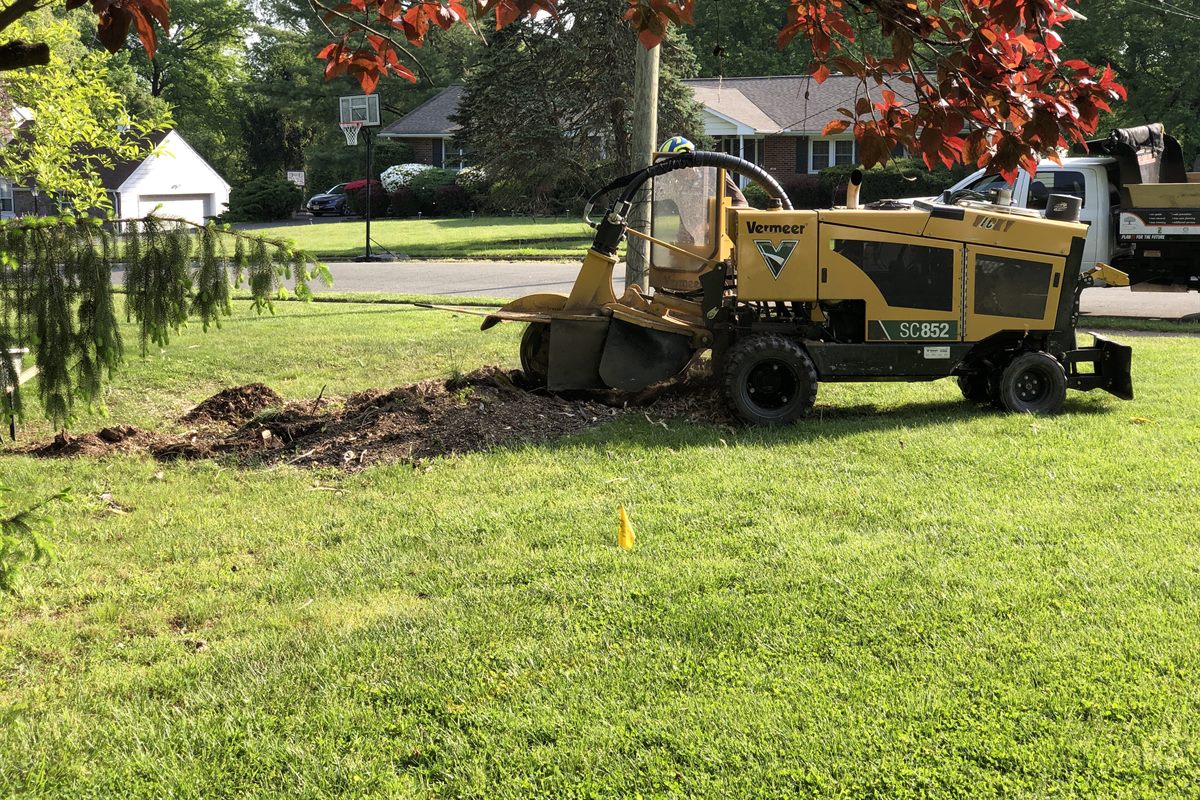
Removal itself is usually modest work. Most front-yard Bradford pears are small or medium trees, so a takedown generally runs $300 to $1,500 depending on size and access, and stump grinding afterwards runs $100 to $400 per stump. Sizes and access factors are broken down in the Garner tree removal cost guide, and the replanting guide covers preparing the spot for whatever goes back in.
Frequently Asked Questions
At what age does a Bradford pear split?
NC State does not put an age on it, and neither will we. What the publication does say is that mild or moderate storms cause excessive branch and main stem breakage, and that the tree can eventually break under its own weight. The structure of the union matters far more than the birthday: a tree with three tight stems is at risk long before a tree that happened to grow one dominant stem.
Can a split Bradford pear be saved with cables or bolts?
Sometimes, and it is rarely worth it on this species. Cabling and bracing is specialist arborist work, it needs inspecting every year or two, and on a tree with several weak unions you are propping up one failure point while the others wait their turn. If you want that assessed properly, use a certified arborist through the ISA “Find an Arborist” directory or the Wake County office of NC Cooperative Extension. We do not diagnose trees; we quote the removal or the pruning.
My Bradford pear lost half its crown in a storm. Now what?
Usually removal. A pear that has shed one main stem is unbalanced, carries a large open wound down the trunk, and has the same weak unions holding up everything that is left. Clearing storm-broken wood is its own job, and our ice storm tree damage guide covers what is urgent and what can wait.
Are Bradford pears illegal in North Carolina?
No, and nothing here says otherwise. What exists is the voluntary bounty program that swaps a free native tree for one you remove, plus a good deal of public advice against planting more. Rules on what you may plant or remove vary by parcel, scope and jurisdiction, so any question about a specific property is one for your town or county office.
Do the stumps and roots sprout back?
Bradford pear is persistent from the base, which is why you see suckers around old stumps and along fence lines. Grinding at $100 to $400 per stump takes the stump below grade, and any sprouts that follow are easiest to deal with while they are small and green.
Do you remove Bradford pears in Clayton and Knightdale?
Yes. These are usually quick, tidy jobs across Clayton, Knightdale, Fuquay-Varina and Willow Spring as well as Garner itself, and a front-yard pear with clear access is one of the simpler removals on a residential lot.
Split Bradford Pear in Garner, Clayton or Knightdale?
If a union has cracked, or half the crown is already on the lawn, the next step is a written number and a date. We take Bradford pears down across Garner, Clayton, Knightdale and Fuquay-Varina, prune the young ones that are still worth shaping, and grind the stump so you can plant something with a future in the same spot.
Tell us about the tree or call (919) 322-8083 during business hours, and you get a free written quote with a clear scope and an up-front written price before anything is booked.
Sources: NC State Extension: Callery Pear, Bradford Pear, Other Varieties, and Their Invasive Offspring · NC State News: Bradford Pear Bounty Returns to North Carolina · NC Bradford Pear Bounty