Ice Storm Tree Damage in NC: What to Do
Garner Tree Removal • September 15, 2026 • 9 min read
Ice is the quietest way to lose a tree in this part of North Carolina. Summer thunderstorms announce themselves and do their damage in twenty minutes. An ice storm arrives overnight, loads every branch evenly, and the failures start as a series of cracks in the dark with no wind involved at all.
Around Garner and out through Clayton and Zebulon the trees that suffer are specific and predictable, which means there is something useful to do about them before the forecast turns. This guide covers why ice does what it does, which species fail first here, what is genuinely urgent at 6am versus what can wait for daylight, and what the cleanup costs.
Every figure here is a planning range for this market, not a quote.
Why Does Ice Bring Down Trees That Wind Does Not?
Because ice loads a canopy evenly and adds weight a tree was never built to hold, while wind loads it unevenly and intermittently. A quarter inch of accumulation on a mature hardwood canopy adds a load measured in tons, and unlike wind it does not let up between gusts. The branch carries it continuously until something gives.
Three consequences follow, and they explain most of what you see afterwards:
- Failures happen without wind. People assume a calm morning means the danger has passed. The opposite is true: loaded limbs come down in still air, which is why standing under one to look at it is the wrong instinct.
- The damage is distributed, not directional. A wind event knocks trees down one way. An ice event breaks limbs throughout a canopy on every side, so a tree can look intact from the street and be half-destroyed from the back.
- It is worst on the fine stuff. Ice collects on twigs and small branches, which is where the surface area is. That loads the outer canopy, the part with the most leverage against the branch union.
Then the temperature rises, the ice sheds, and the tree springs back. Limbs that bent without breaking may be cracked at the union and back in position, which is the damage nobody sees until the next event.
What Fails First Around Here
The species mix in the older Garner neighborhoods is the reason ice storms hurt more here than the accumulation numbers suggest.
| Tree | How it fails under ice | Read |
|---|---|---|
| Bradford pear | Splits at the tight V-shaped trunk union, often the whole tree | The single most ice-vulnerable tree in these subdivisions |
| Water oak | Limb shedding and whole-branch failure; NC State Extension puts the species at 30 to 50 years and notes it can start breaking apart at maturity from rot | The older neighborhoods are full of them at or past that age |
| Willow oak | Fine outer branches shear off in quantity; the structure usually survives | Messy, rarely fatal to the tree |
| Loblolly pine | Tops snap, and beetle-stressed trees go first | A pine with a browning crown and S-shaped galleries under the bark was already failing |
| Sweetgum, red maple | Long horizontal limbs break where the weight is at the far end | Predictable from the shape before any ice arrives |
| Crape myrtle | Bends dramatically, usually recovers | Looks catastrophic, mostly is not |
The pattern worth internalising: tight unions and long overextended limbs are what break. Those are both visible in July, which is the argument for dealing with them then rather than in January.
Want the overextended limbs off before the next winter? Request a free written quote and we walk the property, then price whatever the tree actually needs.
What Is Urgent, and What Can Wait
The morning after, everything looks like an emergency and most of it is not. What matters is not how bad the tree looks but what is underneath it.
Call the utility, not a tree company: anything touching or near a power line. Duke Energy runs a 24-hour emergency line for downed lines, arcing and fire risk, and only qualified line-clearance personnel should be near an energized line. Note also that the line from the pole to your meter is the property owner’s responsibility to keep clear, and Duke will de-energize it at no cost on request before tree work happens; the whole boundary is in our guide to what Duke trims and what you own.
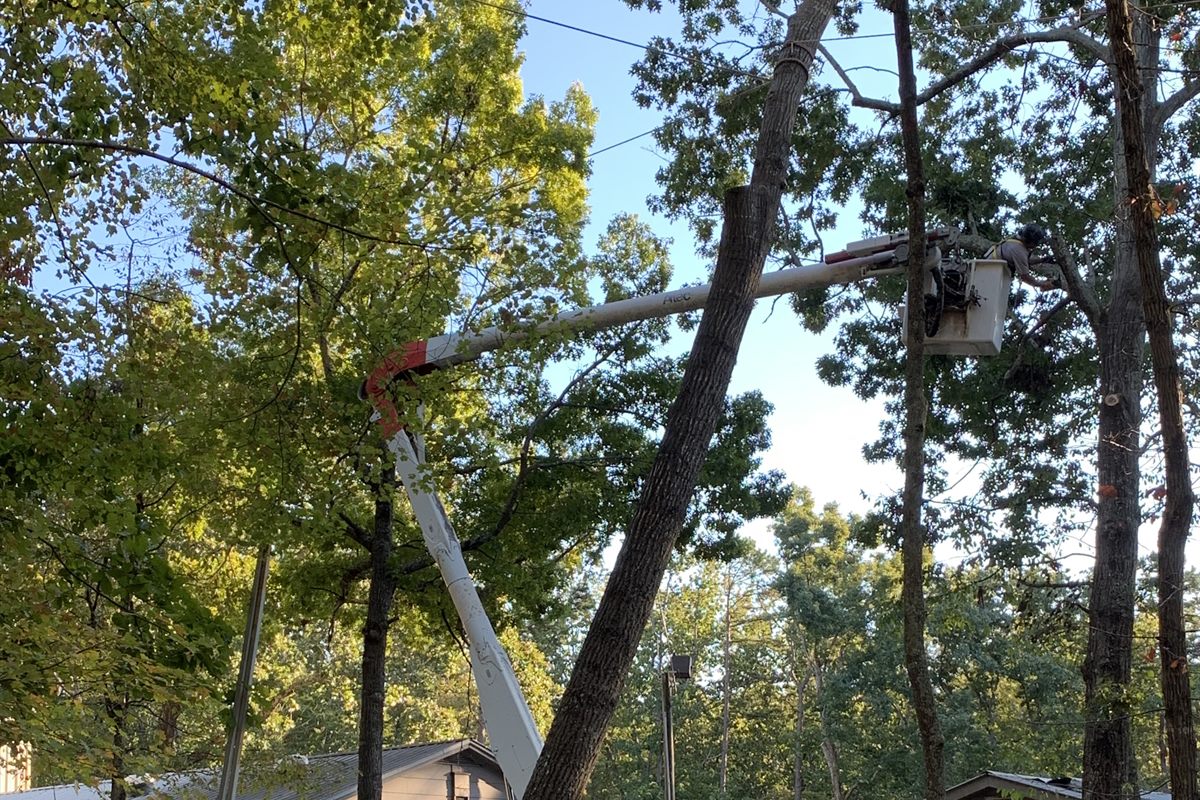
Genuinely urgent, and a 24-hour service rather than us: a limb resting on a roof with weight still in it, a hung-up branch over a walkway or driveway, a split trunk still standing. We do not run an after-hours crew, so those are calls to a company that does.
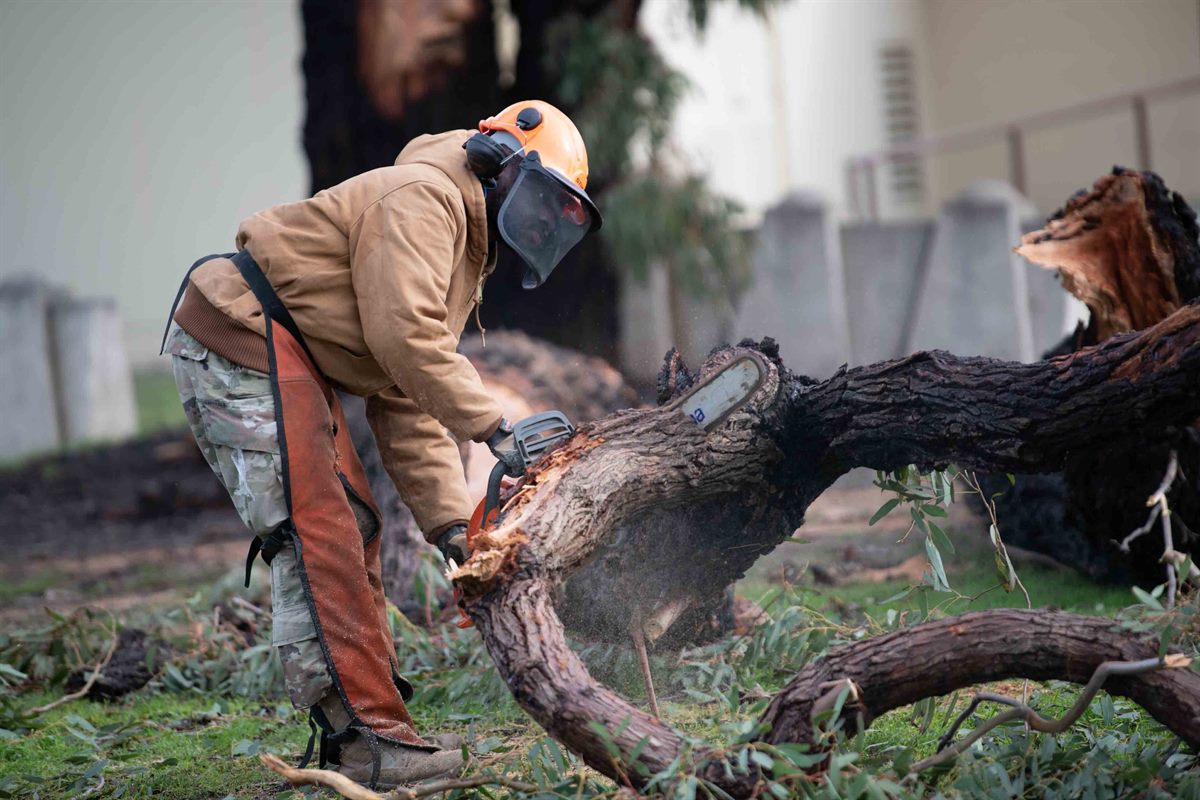
Can wait for daylight and ordinary scheduling, which is also cheaper: a tree or limb down in the yard hitting nothing, broken branches lodged in the canopy over open ground, a bent tree that is clear of structures, general debris. That is the bulk of what an ice storm produces, and it is planned work at planned-work rates.
Pro tip: do not knock ice off branches to help. It feels productive and it is one of the more reliable ways to break a limb that would otherwise have survived. Frozen wood is brittle, the branch is already at its load limit, and a broom handle is enough to finish it. Let it melt.
The Damage You Cannot See Until Later
This is the part specific to ice, and it is why an ice storm shows up in tree bills twice.
When a loaded limb bends without snapping, the wood fibres can crack at the union while the branch returns to roughly its original position once the ice sheds. From the ground it looks fine. The next wind event, or the next ice event, finds the weakness and finishes it. Similarly, a tree that lost a third of its canopy on one side is now unbalanced in a way it was not designed for, and the remaining limbs are carrying loads they never carried.
So the useful thing to do a few weeks after an ice event is look up properly: at branch unions rather than at the ground, for cracks, for limbs sitting at a slightly different angle than their neighbours, for fresh tears in bark where a limb pulled. The four checks for whether a tree is dead or declining cover the related question of whether the tree is going to recover at all.
For a formal determination on a tree you are worried about, that is a certified arborist’s job rather than ours; we quote the work their report calls for.
What Ice Storm Cleanup Costs
| Work | Typical 2026 range |
|---|---|
| Brush and limb debris cleanup | $300 to $800 |
| Tree already on the ground, no structure hit | $300 to $1,200 |
| Deadwooding and broken-limb removal from a crown | $400 to $900 |
| Crown clean on a damaged mature hardwood | $900 to $1,500 |
| Medium tree removal, 30 to 60 ft | $500 to $1,500 |
| Large tree removal, 60 to 80 ft | $1,500 to $3,000 |
| Technical or over-structure removal | $2,500 to $6,000+ |
| Stump grinding | $100 to $400 per stump |
Two things move those numbers after a regional ice event. Demand is the first: every tree service in the area books solid in a single night, and prices follow demand. Access is the second, since frozen or saturated ground changes what equipment can reach a tree. Full breakdowns by size are on the Garner cost page and in the statewide cost guide.
On the insurance side, the short version is that a policy usually pays only once a covered peril has brought the tree down onto something insured, and standing damage is generally the owner’s cost. Detail is in does insurance cover tree removal in NC. General information, not insurance advice.
Frequently Asked Questions
How much ice does it take to cause damage?
Damage starts well below the accumulations that make the news. A quarter inch on a mature canopy is enough to bring down limbs, and half an inch is enough to take whole trees in vulnerable species. What matters more than the number is what the tree was carrying beforehand: an overextended limb or a tight union fails at accumulations a sound tree shrugs off.
Will my broken tree recover?
Often, if the trunk is sound and it kept most of its canopy. A tree that lost under about a quarter of its crown usually recovers with clean-up pruning. Past roughly half, recovery is slow and the tree spends years throwing weak growth. A split trunk or a broken main leader is generally a removal.
Should I prune before winter to prevent ice damage?
Yes, and it is the cheapest tree work available. Reducing end weight on overextended limbs and relieving tight unions is exactly what ice exploits, and pruning for it costs a fraction of removing the tree afterwards. Late winter dormancy is the usual window, so the practical move is booking in autumn for work before the season turns.
Do you clean up ice damage in Clayton and Zebulon?
Yes. Ice cleanup is ordinary scheduled work across Clayton, Zebulon, Knightdale and Wendell, as well as Garner itself. What we do not do is turn out overnight during the storm.
The tree is bent over but not broken. What now?
Give it time before deciding. Many bent trees, especially young ones and crape myrtles, straighten over weeks as the wood recovers. What to watch for instead is soil movement at the base: cracked or heaved ground on the side opposite the lean means the root plate shifted, which is a different and more urgent problem covered in tree leaning toward the house.
Why is everyone booked after an ice storm?
Because a regional ice event damages thousands of trees in one night, and the crews available do not change. That is also why the work you can schedule rather than rush is worth scheduling: you are buying at a normal rate in a market that has temporarily stopped being normal.
Ice Damage Cleanup in Garner and East Wake
Once the hazard is stable, ice cleanup is ordinary work: limbs down, brush chipped, damaged crowns cleaned up, and removals where the tree will not recover. We quote removal, pruning and stump grinding in writing across Garner, Knightdale, Clayton and Zebulon.
For a limb on the roof right now, or anything near a line, call a 24-hour service or Duke Energy first. For everything after that, request a free written quote or call (919) 322-8083 during business hours. The cheapest version of this job is the pruning you do in October.
Sources: NC Extension Gardener Plant Toolbox: Quercus nigra · NC Forest Service: Southern Pine Beetle Prevention Program · Duke Energy: Distribution Line Vegetation Management · NC State Extension: Handling Storm Damage in the Landscape