Do Tree Stumps Attract Termites in NC?
Garner Tree Removal • November 15, 2026 • 6 min read
Yes, a dead stump can feed termites, but a stump on its own does not decide whether your house gets them. Subterranean termites are common in North Carolina soil. What matters is how close the stump is, how wet the ground and wood stay, and whether anything gives termites an easy way into the house.
Pest and tree-company blogs tend to make this sound more alarming than it is. This guide gives the balanced version, based on NC State Extension and Clemson: what stumps really do, what raises the risk, what to check first, and when grinding is worth doing.
Do Tree Stumps Attract Termites?
Stumps and old roots are food, so termites will find them, but they find them by wandering rather than by being drawn from across the yard. NC State Extension says stumps and wood debris in the yard “will eventually become” a food source for termites, and its termite bait guidance describes termites finding the roots of a stump during normal foraging, the same way they find any underground food.
NC State also notes that termites are part of how nature recycles dead wood. Finding termites in a rotting stump is common and is not, by itself, a sign that the house is infested. Its eastern subterranean termite guide says swarmers seen near a stump are not an indication that your house is infested.
The question is not “is there a stump” but “is there a path from the stump to the house.”
What Actually Raises the Risk to Your House?
Moisture and an easy route in count for more than the stump. Subterranean termites need a constant supply of moisture, and NC State calls moist wood one of the most significant conditions for an infestation.
| What you see | Lower concern | Higher concern |
|---|---|---|
| Stump distance from the house | Well out in the yard | Close to the foundation, porch or deck posts |
| Stump condition | Dry, sound, or freshly cut | Soft, spongy, wet, or full of mud tubes |
| Soil near the house | Drains away from the foundation | Stays wet from a gutter, leak or low spot |
| Wood touching soil | Siding and trim well above the ground | Steps, posts or siding touching soil or mulch |
| Mulch | Kept back from the foundation | Piled against siding or foundation |
| Termite protection | A current inspection or treatment | Never inspected |
No extension page we reviewed gives a safe distance, so be wary of anyone who quotes one. Closer is riskier. NC State lists wood-to-ground contact as an easy way in.
Unsure about a stump near your house? Request a free quote and we’ll contact you to discuss the tree, the access, and the work you need.
Pro tip: the quickest check for most Garner yards takes five minutes. Walk the foundation and look at where soil, mulch or leaves touch wood, and where a downspout or low spot keeps the ground wet. Fixing those costs less than any stump decision, and they are the points NC State and Clemson both stress.
What Do Pest Blogs Overclaim?
A few claims show up again and again and do not hold up.
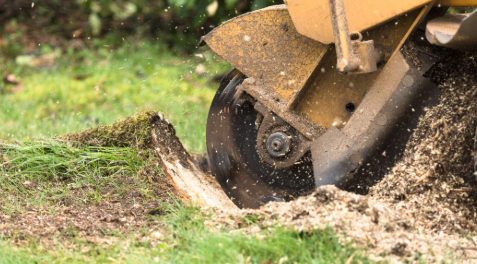
- “Grinding the stump prevents termites.” Grinding removes the stump down to 6 to 12 inches below grade. The roots stay in the ground, and termites in the soil are untouched. Grinding takes away one food source, not the risk.
- “Every stump near a house must go.” Clemson recommends removing cellulose debris in or near a structure, which is a fair general rule, but NC State’s advice for protecting a house centers on moisture and wood-to-ground contact.
- “Grindings will invite termites.” Loose chips are not a special attractant, but grindings piled against a foundation act like thick mulch. Keep them away from the house.
Termite inspection and treatment belong to a pest management professional. Stump grinding is what we do, and the two jobs fit together in a sensible order.
What About Carpenter Ants and Fungi?
Stumps host other things too, and they are easy to confuse with termites.
Carpenter ants nest in stumps, logs and dead trees. NC State says they prefer wood at 15 percent moisture or higher, and that, unlike termites, they do not eat the wood, they tunnel through it.
Fungi are what rot a stump in the first place. The mushrooms and soft spots that come with rot mean the wood is wet and decaying, which is the condition both termites and carpenter ants prefer. A stump that is softening is a bigger draw than one that is still dry and hard. If mushrooms are showing at the base of a tree that is still standing, that is a separate question.
When Does Grinding a Stump Help?
When the stump is close to the house, wet and rotting, or simply in the way. A short decision path works for most yards.
- You have seen mud tubes, swarmers or soft damaged wood near the house. Call a pest management professional first and ask whether to grind before or after treatment.
- The stump is within a few feet of the foundation, deck or porch. Grinding removes the wood above ground and gets rid of a likely nest site. A deeper grind, with the chips kept away from the structure, makes sense here.
- The stump is far out in the yard and sound. Termite risk is a weak reason to grind. Do it if it bothers you, trips you or blocks the mower.
- The stump is rotting and wet. It is a better home for ants and termites, and it only gets worse. Grinding is the cleaner fix.
Grinding runs $100 to $400 per stump, about $3 to $6 per inch of width, with a trip minimum if the machine comes out for one small stump. The Garner price guide has the details, and stump grinding vs stump removal explains what grinding leaves behind.
Want the stump gone? Ask for a free written quote on the contact page.
Frequently Asked Questions
Do stump grindings attract termites?
Not on their own, but loose wood chips piled against your foundation can act like thick mulch and hide termite activity. Spread grindings away from the house, or see what to do with stump grindings.
How close does a stump have to be to the house to matter?
No extension page we reviewed gives a number. Treat a stump within a few feet of the foundation, porch or deck as worth dealing with, and a stump across the yard as low concern unless the ground stays wet.
Will grinding kill the termites in a stump?
No. Grinding removes the wood, but termites in a stump are usually part of a colony that lives in the soil. If you know termites are present, a pest management professional should assess the property, and grinding fits around that plan.
Is a freshly cut stump a termite risk?
Less than an old, wet one. A fresh stump is sound wood, and the roots below it start to decay slowly. Rotting is what makes it more appealing, and a stump grinding visit right after the tree removal takes that off the list.
Should I leave the stump alone if I find termites in it?
Get the property checked before disturbing it. Termite treatment is a pest professional’s work, and they can tell you when grinding makes sense.
Stump Grinding in Garner, Clayton and Knightdale
We grind stumps across Garner, Clayton, Knightdale, Wendell and east Wake County, with an up-front written price before any work starts. When we contact you, we’ll ask where the stump sits so the depth and cleanup can be planned.
Request a free quote or call (919) 322-8083. Sources: NC State Extension on termites after storms, eastern subterranean termites and carpenter ants, and Clemson on subterranean termite control.