When to Prune Oak Trees in North Carolina
Garner Tree Removal • September 20, 2026 • 10 min read
Half the pruning calls we get in Garner come in August, when a homeowner is looking up at a willow oak hanging over the roof in full leaf and deciding something has to be done about it. The instinct is right and the timing usually is not.
Oaks are the signature tree of this part of Wake County. Willow oaks over older streets, water oaks in back yards, the odd white oak somebody’s grandparents planted. They respond well to pruning and badly to being pruned carelessly, and the difference between the two is mostly about when you cut, how much you take and where the cut lands.
This guide covers the dormant-season window for the Triangle, what can come off at any time of year, how much of a crown you can remove in one season, and the one thing you never do to an oak no matter how tall it has got. Every dollar figure here is a planning range for this market, not a quote.
When Is the Best Time to Prune Oak Trees in NC?
Prune oaks in the dormant season, which in the Triangle means roughly February into early March: late enough that the hard freezes are behind you, early enough that the tree has not broken bud. NC Cooperative Extension guidance for eastern North Carolina puts the broader dormant window at January through mid-March, and oaks are on the list of trees suited to it along with maple, sweetgum and sycamore.
Three things make that window the right one:
The structure is visible. With the leaves off, you can see crossing limbs, included bark at a union, deadwood and the actual shape of the crown. Pruning an oak in full leaf is guesswork with a saw.
The cuts close fast. Wounds made just before the spring flush seal quickly once growth resumes. NC State Extension is explicit about the other end of the calendar: delay pruning until late winter or early spring rather than cutting in autumn, when decay fungi are sporulating and looking for an opening.
Disease and pest pressure is at its lowest. Dormant trees and dormant insects go together, which is a large part of why the branching-pattern advantage is not the only reason to wait.
One caution that belongs with it: avoid pruning right before or right after a hard freeze. If a cold snap is forecast for the weekend, the cut can wait until the following one.
What Can Be Pruned at Any Time of Year?
Dead, broken and hazardous limbs come off whenever you find them, season be damned. NC State Extension states it directly: remove broken, dead, weak or heavily shaded branches anytime.
That is the distinction that matters most in practice, because the two jobs are not the same job:
| Type of work | Best timing | Why |
|---|---|---|
| Structural pruning, crown thinning, shaping | February into early March | Structure visible, fast wound closure, low pest pressure |
| Dead, broken or hanging limbs | Any time, as soon as found | It is a hazard, not a horticultural decision |
| Storm damage cleanup | Immediately | Torn limbs and hangers do not wait for a calendar |
| Clearance from a roof, drive or power drop | Dormant season if planned; any time if urgent | Urgency beats optimal timing |
| Heavy reduction on an old oak | Dormant season, and lightly | Mature trees tolerate less removal |
| Pruning a City street tree in Raleigh | After the permit, whatever the season | The City manages those trees |
That last row catches people out. A tree in the right of way is the City’s, and in Raleigh even trimming one falls under a Tree Impact Permit. Requirements vary by parcel, scope and jurisdiction, and the town or city office makes the determination, so the question is worth settling before a saw comes out rather than afterwards.
Want the exact number for your oak? Request a free written quote and we walk the property first, then price it in writing.
How Much Can You Take Off an Oak in One Season?
NC State Extension sets the ceiling at no more than a third of a plant’s total crown in any one year, and on a mature oak the working rule should be tighter than that: about a quarter of the live crown in a season, less on an old tree.
Extension is specific about why older trees need a lighter hand. Do not prune excessively during the dormant season, particularly on large mature trees, and do not remove a large number of branches thicker than about 2 inches in diameter. Every leaf is a factory; strip too many at once and the tree spends the next two seasons paying for it with weak epicormic shoots rather than sound growth.
This is where the August phone call usually goes wrong. The tree looks enormous in leaf, the homeowner asks for it to be “cut back hard”, and hard is the one thing a mature oak cannot absorb. Thinning 20% out of a crown changes how wind moves through it and how much light reaches the lawn. Taking 50% changes the tree into a different tree.
Pruning runs $300 to $1,500 in this market depending on size, access and how much rigging the job needs, with the full picture on the Garner tree removal cost page. Two lighter visits across two dormant seasons often cost less in total than one heavy one, because a heavy prune on a big oak is a rigging job.
Pro tip: know which oak you have before you plan a decade of pruning around it. Water oak is the weak link here. The NC Extension Gardener Plant Toolbox puts its lifespan at 30 to 50 years, calls it weaker-wooded than most oaks and notes it can start breaking apart at maturity from rot. The water oaks planted when these Garner neighbourhoods were built are at or past that range, and pruning does not fix rot. Willow oak is the opposite case: 80 to 90 years in urban conditions and well over a century in the woods, so a struggling willow oak usually has a cause worth chasing.
What a Correct Cut Looks Like
Where the cut lands matters as much as when it happens, and this is the part that separates a pruning visit from a hack job.
Cut outside the branch collar. The collar is the slightly swollen ring where a limb meets the trunk, and it contains the tree’s own chemical defence zone. NC State Extension is blunt about removing it: a flush cut takes away the protective zone and increases the chance of fungal organisms infecting the plant. The stub-and-flush pair are the two classic errors, and the flush cut is the worse of them.
Use three cuts on anything heavy. Extension describes the sequence: an undercut 4 to 6 inches out from the collar so the bark cannot rip down into the trunk, a second cut further out that drops the weight of the limb, and a final cut that removes the remaining stub at the collar. Skip the undercut on a heavy limb and the bark peels a strip off the trunk on the way down.
Leave the wound alone afterwards. Pruning paint and wound dressing do not help an oak seal a cut and can slow it down. A clean cut at the collar is the treatment.
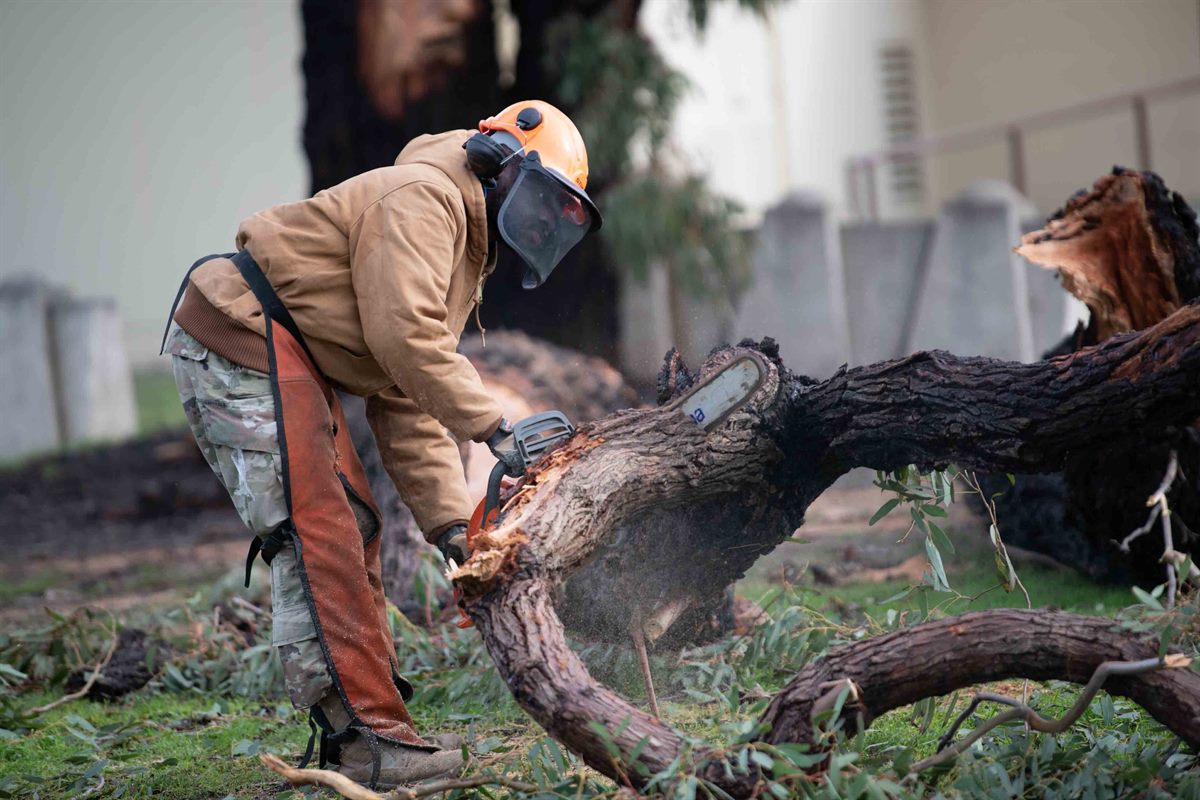
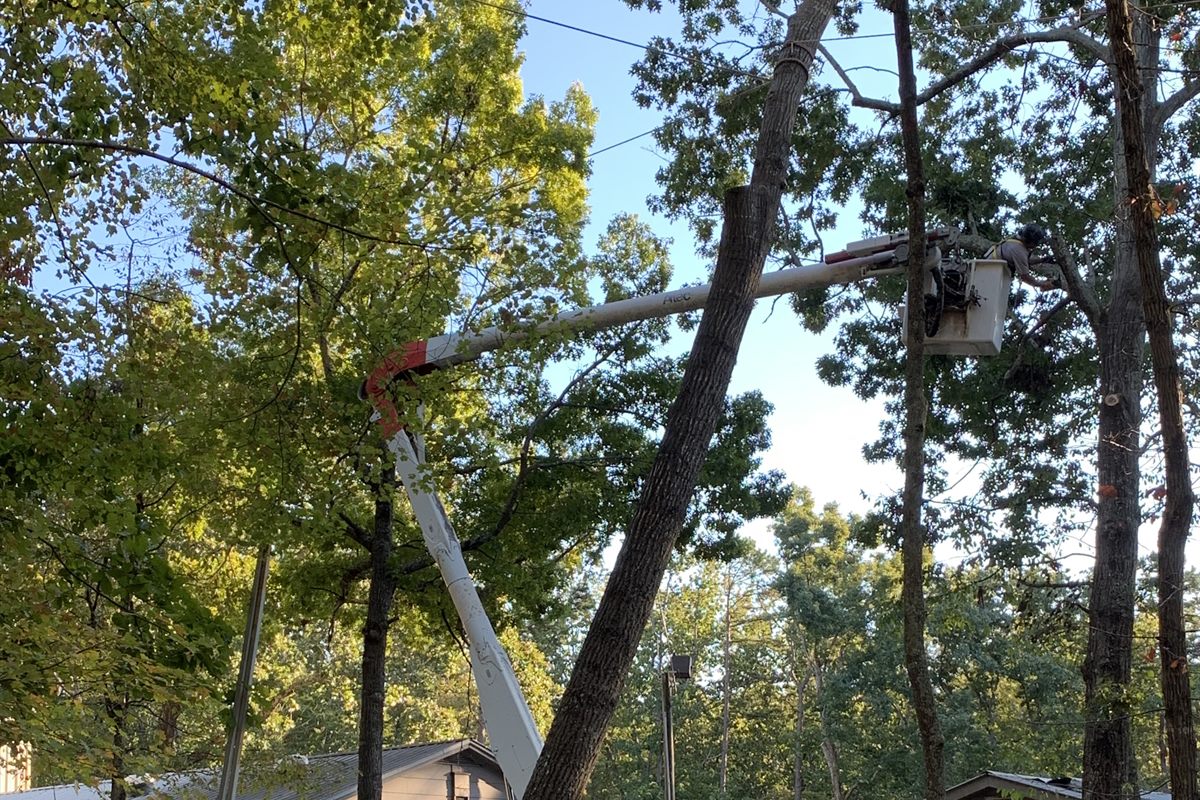
Work from the ground where you can. A pole saw handles most of what a homeowner should be doing. Anything that needs a ladder, a rope or a chainsaw above shoulder height is where the injuries happen, and on a 60 to 80 foot oak over a roof it is large and technical removal territory rather than weekend work.
Why You Never Top an Oak
Topping is cutting a tree back to stubs to reduce its height, and it is the most expensive mistake a homeowner can make with a mature oak. NC State Extension calls it an inappropriate means of reducing height, says the cuts destroy the tree’s architecture, and warns they will likely lead to the entrance of decay-causing organisms.
What happens next is predictable. The tree responds to the loss of its crown by throwing dense shoots from below the cuts. Those shoots grow fast, attach weakly to a decaying stub, and within a decade you have a taller tree with worse structure than the one you started with, plus rot working its way down the stubs. In this region that ends one of two ways: a limb failure in a summer thunderstorm, or a removal you paid to bring forward.
If a tree genuinely is too big for its spot, the honest options are crown reduction done properly across seasons, or removal and replanting something appropriate to the space. A large oak of 60 to 80 feet runs $1,500 to $3,000 to take down, which is real money, and it is still cheaper than topping it now and removing it in eight years anyway. Our pruning versus removal comparison walks the decision.
Frequently Asked Questions
Can you prune oak trees in summer in North Carolina?
You can, and for anything dead, broken or hanging you should, immediately. What waits for the dormant season is structural pruning and crown thinning, because you cannot read the structure through the leaves and the wounds sit open longer. Emergency and clearance work in Clayton or Garner never waits on a calendar.
Is it too late to prune an oak in April?
Once buds have broken you are into the flush, and it is better to wait for the next dormant season for anything structural. Light work will not kill the tree, but the cuts made just before the spring flush are the ones that close fastest, and April misses that window.
How much does oak pruning cost in Garner?
Pruning runs $300 to $1,500 depending on the size of the tree, how much rigging the job needs and how tight the access is, and our tree trimming cost guide breaks that down. A mature willow oak over a roof sits toward the upper end because everything has to be roped down rather than dropped.
Will pruning fix a leaning or rotting oak?
No. Pruning addresses the crown; it does nothing for a lifting root plate, a hollow trunk or advanced rot at the base. Those are structural questions, and where the answer is genuinely unclear, a certified arborist performs that evaluation rather than a removal crew. We do not diagnose trees.
Can I prune the oak in the strip between my sidewalk and the street?
Check first, because that tree may not be yours. In Raleigh, street trees in the right of way are City trees and work on them goes through the Urban Forestry Program, and the City says the right of way is not a fixed distance from the curb. Each town in the area sets its own rules, so ring the planning department for your parcel.
Do you prune oaks in Knightdale and Fuquay-Varina as well as Garner?
Yes. We quote tree trimming and pruning across Garner, Knightdale, Fuquay-Varina, Clayton and the rest of the east Raleigh belt, with the scope written out before anything is cut.
Book Oak Pruning in Garner, Raleigh and East Wake
The dormant window is short and it fills up. If you have an oak you have been meaning to deal with, the time to get it looked at is autumn, so the work is scheduled for February rather than argued about in July.
We quote tree trimming and pruning, removal and stump grinding across Garner, Raleigh, Knightdale and Clayton, with an up-front written price and the cuts agreed before we start. Request a free written quote or call (919) 322-8083 during business hours, and if the tree needs nothing this year, we will tell you that instead.
Sources: NC State Extension: General Pruning Techniques · N.C. Cooperative Extension, Carteret County: What to Prune and When · NC Extension Gardener Plant Toolbox: Quercus nigra