Can Tree Roots Damage a House Foundation?
Garner Tree Removal • September 20, 2026 • 10 min read
There is a hairline crack stepping through the brick above the garage, the back door has started catching, and twelve feet off that corner stands a willow oak that was there before the house. Every search you run says the same thing: the tree is doing it, cut the tree down.
Sometimes that is right. More often it is the most expensive guess available, because a mature shade tree in Garner is worth real money in cooling and in kerb appeal, removal cannot be undone, and the crack frequently has a cause the tree had nothing to do with. Worse, taking out a large tree beside a house is not automatically a neutral act either.
This guide covers what tree roots damaging foundation walls actually looks like, the four mechanisms that cause the damage people blame on roots, how to tell them apart before you spend anything, and what the tree work costs if removal turns out to be the answer. Every figure here is a planning range for this market, not a quote.
Can Tree Roots Damage a House Foundation?
Roots almost never break a sound foundation by pushing against it. Where trees do cause foundation trouble it is nearly always through the soil, by drawing water out of it, and the damage you can actually see from the yard is usually to slabs, walks and drive aprons rather than to the footing itself. Roots follow the path of least resistance, and poured concrete is not it.
Four separate things get reported as “tree roots damaging foundation”, and they call for four different phone numbers.
| What is happening | What it looks like | How worried to be |
|---|---|---|
| Roots drying out shrinkable soil in a dry spell | Cracks that open in late summer and close again after a wet winter, doors sticking seasonally | Depends entirely on your soil. A structural engineer or foundation contractor measures this, not an arborist and not us |
| Surface roots lifting flatwork | A driveway, patio, walk or garage slab tilted or cracked along a line running back to the trunk | Common, ugly, rarely structural |
| Roots inside a sewer lateral | Slow drains, repeat backups, gurgling, a wet patch over the line | The roots are the symptom. The pipe leaked first |
| A root plate lifting as the tree itself starts to fail | Soil heaved or cracked near the trunk, the tree tilting, roots rising on the high side | Not a foundation problem at all. A tree problem, and the urgent one on this list |
Only the last row is an emergency, and it is the one homeowners notice last. If the soil around the trunk has moved, deal with the tree before you deal with the brick: get a free written quote and we walk the property, then price the work in writing.
Where Tree Roots Actually Go
The mental picture most people carry is wrong in two ways, and both matter for this question.
Roots go much wider than the canopy. NC Cooperative Extension puts it plainly: tree roots can grow two to three times as wide as the tree is tall, which means the drip line is nowhere near the edge of the root system and “I planted it twenty feet from the house” buys far less protection than it sounds like. A loblolly running 90 feet along a Garner property line has roots under most of the lot.
Roots also stay shallower than people expect. The absorbing roots sit in the top layer of soil where the oxygen and the water are, which is exactly why they surface through thin turf, why they run under driveways, and why they lift flatwork. A slab or a walk sits on grade with nothing holding it down; a foundation footing sits below it in a trench with a house on top. That difference is why the same root that tilts your front walk does nothing at all to the wall ten feet away.
What roots do not have is the ability to force their way into sound concrete. They exploit a gap that already exists, then thicken in it. That is a repair problem, and it is the same principle that governs the sewer question.
The Sewer Line Question
This is the one worth getting right before anyone quotes you for a removal, because the fix is usually the pipe rather than the tree.
NC Cooperative Extension is direct about it: tree roots cannot create cracks in a sewer pipe, they can only exploit existing cracks or gaps, so roots in the line mean the line was already leaking. Old clay tile and cast iron joints are the vulnerable ones and they are common under houses of a certain age across Garner and older Raleigh neighbourhoods. Properly installed PVC resists intrusion.
The practical order is cheap and fast: have a plumber camera the lateral before you blame the tree. If the camera finds a broken joint, removing the tree does not repair it, and the next tree or the neighbour’s tree will find the same break. Work by the USDA Forest Service also found that root damage to sidewalks, curbs and gutters is considerably more pervasive and costly than root damage to sewers, which is a useful sense of proportion when a contractor is standing in your yard talking about roots.
Pro tip: mark and date the ends of the crack in pencil, then photograph it with a tape measure beside it twice a year, once at the end of a dry August and once after a wet February. A crack that opens and closes with the seasons is soil moving with moisture. A crack that only ever gets longer is something else. Either way you now have evidence instead of an argument, and it cost you nothing.
Should You Remove the Tree?
Diagnose the crack before you decide about the tree, because removal is permanent and most cracks have a cheaper cause. The order that saves money runs like this.
- A structural engineer or a foundation contractor who will put the diagnosis in writing. Settlement, heave and a cosmetic mortar crack look similar from a ladder and are not the same problem.
- A plumber with a camera, if there is any drain symptom at all.
- A certified arborist, if the tree’s own condition is in question. We do not perform tree risk assessments or write risk reports; find an arborist through the International Society of Arboriculture’s directory or ask the Wake County Cooperative Extension office who works locally, and read what a hazard evaluation involves first.
- Us, once you know what work the answer calls for.
Two warnings before anyone starts cutting. Root pruning to protect a slab cuts anchoring at the same time: University of Maryland Extension’s working rule is that a tree losing roughly half its root system probably should be removed, so a trench dug between a big tree and the house can convert a foundation worry into a hazard worry, and the leaning tree signs are what you would be watching for afterwards. Root barriers are real and they work, but where they go relative to the anchoring roots is a decision for the arborist and the contractor doing the install, not a guess with a spade.
The second warning is the one nobody mentions. A large tree next to a house is pulling water out of that soil every summer. Take it away and the soil rehydrates. Where soil swells as it rewets, that movement is its own problem, which is another reason to have the soil and the footing diagnosed by someone qualified before the saw comes out.
What the Tree Work Costs
| Work | Typical 2026 range |
|---|---|
| Small tree removal, under 30 ft | $300 to $800 |
| Medium tree removal, 30 to 60 ft | $500 to $1,500 |
| Large tree removal, 60 to 80 ft | $1,500 to $3,000 |
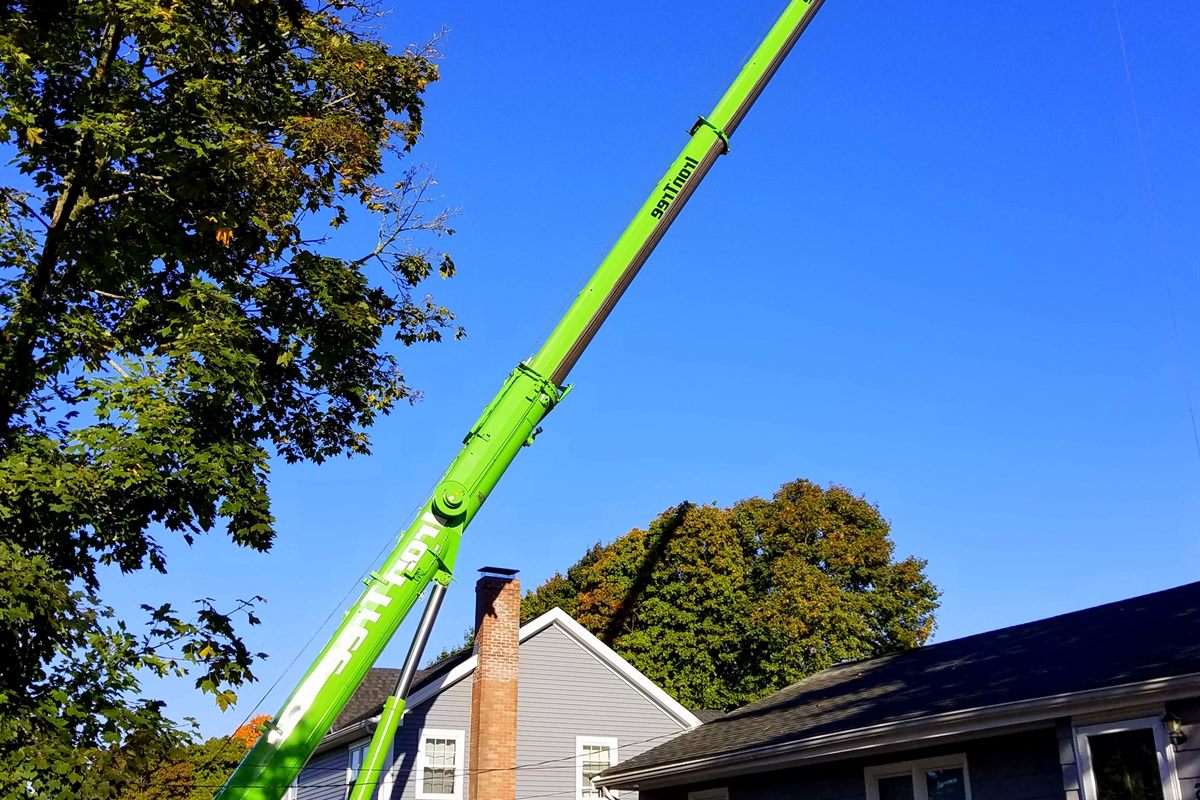
| Technical, over-structure or crane-assisted | $2,500 to $6,000+ |
| Stump grinding | $100 to $400 per stump |
A tree growing hard against a foundation almost never prices in its size band, for a straightforward reason: there is nowhere to drop it. The work becomes dismantling in sections on ropes, sometimes over a roof line, which is rigging rather than felling. Full breakdowns by size and access are on the Garner cost page and in the statewide cost guide.
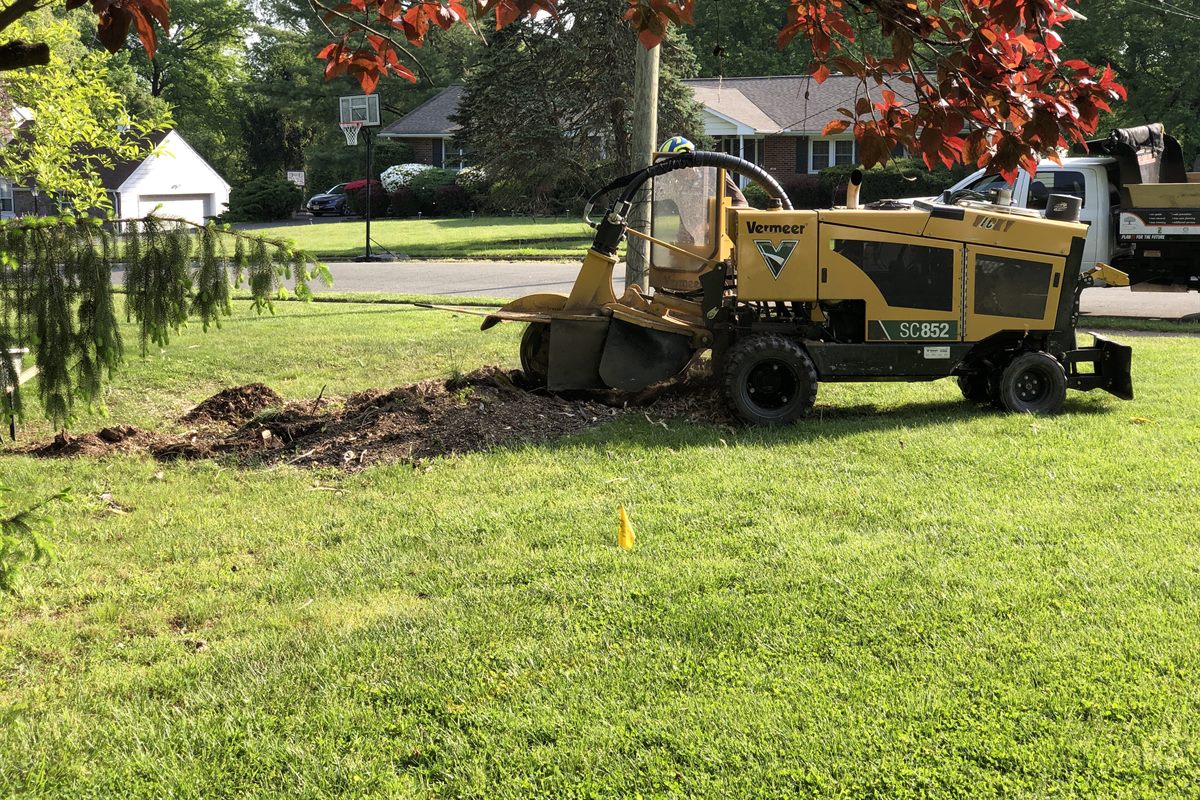
One detail in your favour next to a foundation: stump grinding is mechanical removal of the stump to roughly 6 to 12 inches below grade and leaves the root system in the ground to decay in place. No excavator digging against your footing, which is exactly what you want within a few feet of the house.
Frequently Asked Questions
How far from the house should a large tree be?
There is no single safe number, which is why the rules of thumb on the internet all disagree. Roots run two to three times the tree’s height, so distance alone never settles it; what matters is the species, its mature size, the condition of the trunk and root plate, and what is in the fall path. A 25-foot dogwood at ten feet is fine. A water oak at ten feet is a conversation.
Will removing the tree fix my foundation crack?
Usually not on its own. Removal stops the tree drawing water from that soil, but it does not repair a crack that has already opened, and in soils that swell when they rewet it can add movement of its own. Get the written diagnosis first, then decide whether the tree is part of the answer.
Can tree roots crack a driveway or a patio slab?
Yes, and this is the common one. Flatwork sits directly on grade with no weight holding it down, so a root thickening underneath lifts it easily. That is a concrete repair and a root-management question rather than a structural emergency, and grinding or removing the tree is only one of the options.
My neighbour’s tree roots are under my foundation. Who is responsible?
North Carolina applies the ordinary common law negligence standard to trees rather than strict liability, and liability turns on actual or constructive notice of a dangerous condition. Put any concern in writing and keep a copy, because a written complaint is how notice gets created; the same principle is set out in who is responsible for a fallen tree. This is general information, not legal or insurance advice.
Do roots keep growing after the tree comes down?
The root system stops expanding once the top is gone, and the roots decay in place over several years. Some species push sprouts from the stump or the roots until the stump is ground and the sprouts are cut back, which is worth budgeting for in the same visit rather than as a second trip.
Do you work in Raleigh and Fuquay-Varina?
Yes. Close-quarters removals beside houses and driveways are routine across Raleigh, Fuquay-Varina, Clayton and Archer Lodge, as well as Garner itself.
Tree Work Next to the House in Garner and East Wake
If the diagnosis comes back pointing at the tree, the next step is a written price rather than another opinion. Close-quarters removal, rigging over a roof line and stump grinding beside a foundation are ordinary scheduled work for us across Garner, Raleigh, Clayton and Fuquay-Varina.
Request a free written quote or call (919) 322-8083 during business hours, and you get an up-front written price covering the takedown, the cleanup and the stump. If the crack looks like something other than the tree to us, we will say so before you spend the money.
Sources: NC Cooperative Extension, Union County: Tree Roots and Sewer Lines · USDA Forest Service PSW: Tree Root Intrusion in Sewer Systems · University of Maryland Extension: How Do You Decide When to Remove a Tree? · NC Pro Bono Resource Center: Disaster Assistance Manual, Falling Trees