Crane Tree Removal: When Do You Need One?
Garner Tree Removal • September 20, 2026 • 9 min read
Almost everyone who asks about crane tree removal asks the same way: “the tree is about seventy feet, does that need a crane?” It is a reasonable question and it is aimed at the wrong variable. Height tells a crew how long the job will take. It does not tell them how the wood has to move, and how the wood has to move is the entire decision.
Around Garner and the east Raleigh belt, the trees that end up on a crane are rarely the tallest ones on the street. They are the half-hollow water oak behind a fenced backyard, the standing dead pine nobody can tie into, and the eighty-foot hardwood whose only exit is up and over the house. Meanwhile plenty of genuinely big trees come down with ropes and a ground crew and never see a crane at all.
This guide covers what actually triggers a crane pick, why dead wood is the most common real trigger, how the price band works, and what a crane day looks like on a residential lot. Every figure is a planning range for this market rather than a quote.
When Do You Actually Need a Crane for Tree Removal?
A crane is chosen when the wood cannot be safely climbed, or when the sections have to travel over something they cannot be lowered through. Those are the two triggers, and neither one is a height.
The first is condition. A climber works by tying into the trunk and the major limbs and trusting them with body weight plus the shock load of a rigged piece. Sound live wood takes that. Dead and decayed wood does not, and it fails without warning, which is why dead wood cannot be safely climbed as a matter of practice rather than preference. Once climbing is off the table, the remaining options are a lift or a crane.
The second is access and travel path. If sections have to clear a roof, a pool, a fence line or a neighbour’s property to reach a landing zone, lowering them through the canopy on ropes is either slow or impossible. A crane picks the section, lifts it clear and sets it down at the street. Our large and technical removal page covers how those jobs are planned and priced from the commercial side.
Why Is Dead Wood the Most Common Trigger?
Because it changes the method on a tree that would otherwise be routine. This is the single most common way a homeowner ends up with a crane quote they did not expect, and it is worth understanding in order, because it explains a price gap that otherwise looks arbitrary.
A live sixty-five foot willow oak in an open Garner front yard is a climb and a drop. The climber goes up, takes the limbs, and the trunk comes down in sections. The same oak dead for two seasons is a different job entirely: the anchor points cannot be trusted, the limbs shed on their own, and no responsible crew is putting a person in it. The tree has not grown an inch. The method changed, and the method sets the price.
That is also why a declining tree is cheaper to remove than a dead one. If you have a tree in Clayton or south Raleigh that is thinning, dropping limbs or showing a hollow at the base, removing it while it still holds a climber is the largest saving available on that job. Our guide to telling whether a tree is dead covers the checks that separate dormant from finished.
Crane, Lift or Climber: What Does Your Tree Need?
Three methods cover almost every residential takedown, and they are chosen in this order: climb if the wood allows it, lift if the ground allows it, crane if neither does. Most standard tree removal work around here never gets past the first one.
| Method | When it is chosen | What it needs from the property |
|---|---|---|
| Climber with ground rigging | Sound live wood, anchor points a climber can trust | Very little; works in fenced backyards and tight lots |
| Bucket lift | Wood too poor to climb, but the truck can reach the tree | Firm ground and a clear path wide enough for the machine |
| Crane pick | Wood cannot be climbed, or sections must travel over a structure | Street or driveway setup room, outrigger pads, a landing zone |
Notice what is not in that table: height. A crane is often used on tall trees because tall trees more often sit over houses and more often outgrow a bucket’s reach, but the height is a correlation, not the reason.
Want to know which method your tree needs? Request a free written quote and we walk the property, then price it in writing.
What Does Crane Tree Removal Cost?
Crane-assisted and technical removals in this market run $2,500 to $6,000 and up, against $1,500 to $3,000 for a large tree that can simply be felled or climbed. The gap is method. A crane day brings more equipment, more people, more setup and more planning than a climb, and it is priced accordingly.
What is worth saying plainly is that a crane is expensive per hour and often cheaper per job. Roping a big backyard hardwood down in hundreds of small pieces can run two days with a full crew. The same tree can be four hours of picks. On the jobs where a crane genuinely fits, the crane version is frequently the lower total, and it is always the safer one.
The full size bands, including where a crane job sits against everything else, are on our Garner tree removal cost page, and the statewide picture is in the tree removal cost guide. If your tree is large but nothing about it is technical, the numbers you want are in cost to remove a large tree instead.
Pro tip: ask any bidder to tell you the method before the price. “We will crane it” and “we will climb it” are two different jobs on the same tree, and a bid that does not say which one is not comparable to a bid that does. On older Garner streets, where oaks along Aversboro Road and Timber Drive sit close to the kerb, setup room is often the deciding detail and a walk of the street answers it in minutes.
What Does a Crane Day Look Like on a Residential Lot?
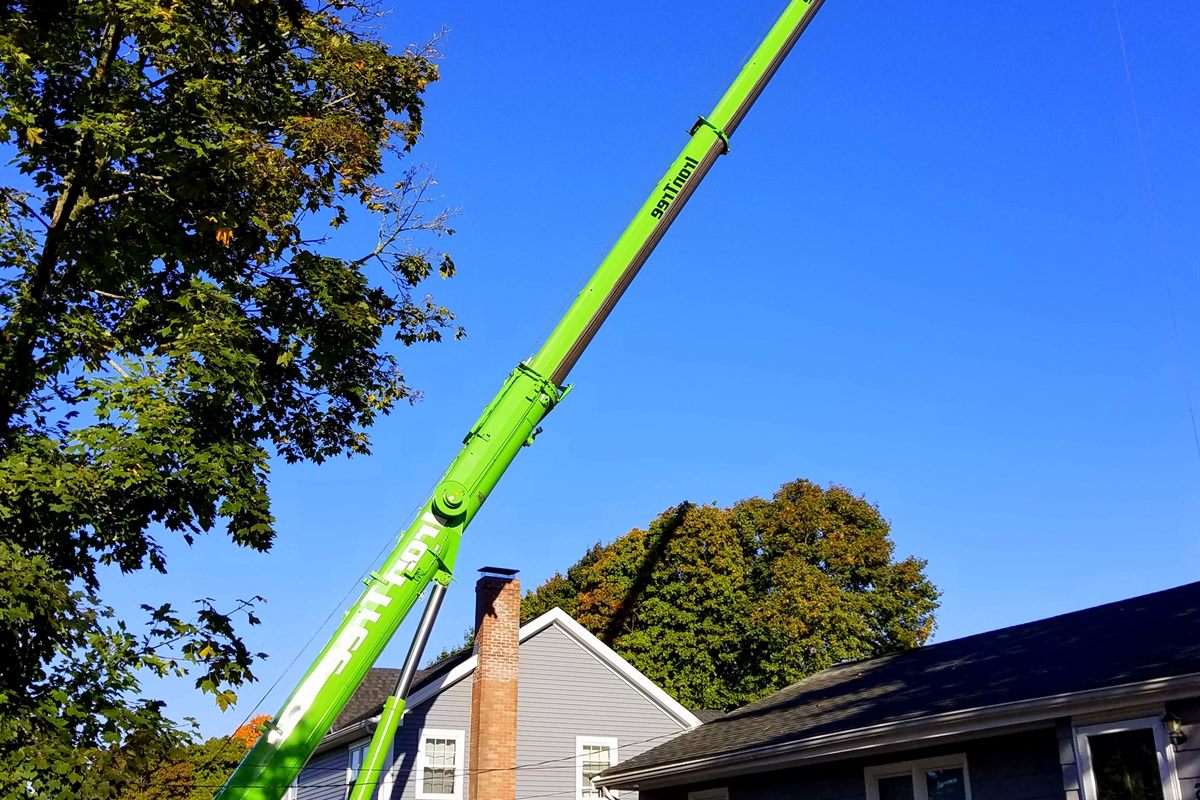
It starts before the crane arrives. Somebody works out where the machine sets up, where the outriggers land, how the boom clears the overhead lines, and where the sections come down. That plan is the job. The cutting is the easy part.
On the day, expect the street or your driveway to be occupied for several hours, plywood or mats under anything with weight on it, and a landing zone where sections are set and then bucked down to chipper size. A climber or a lift operator is still in the tree making the cuts; the crane holds the piece so it never falls. Sections come off in a deliberate order, usually top down and outside in.
Two honest notes. A crane on a residential lot leaves marks, and anyone promising a perfectly untouched lawn has not run many. What a good crew does is decide in advance where the weight goes and protect it. And overhead utility lines are not ours to move: line clearance around the primary conductors belongs to the utility, so if the boom path crosses them that call gets made before anything else. Our post on Duke Energy tree trimming covers where that boundary sits.
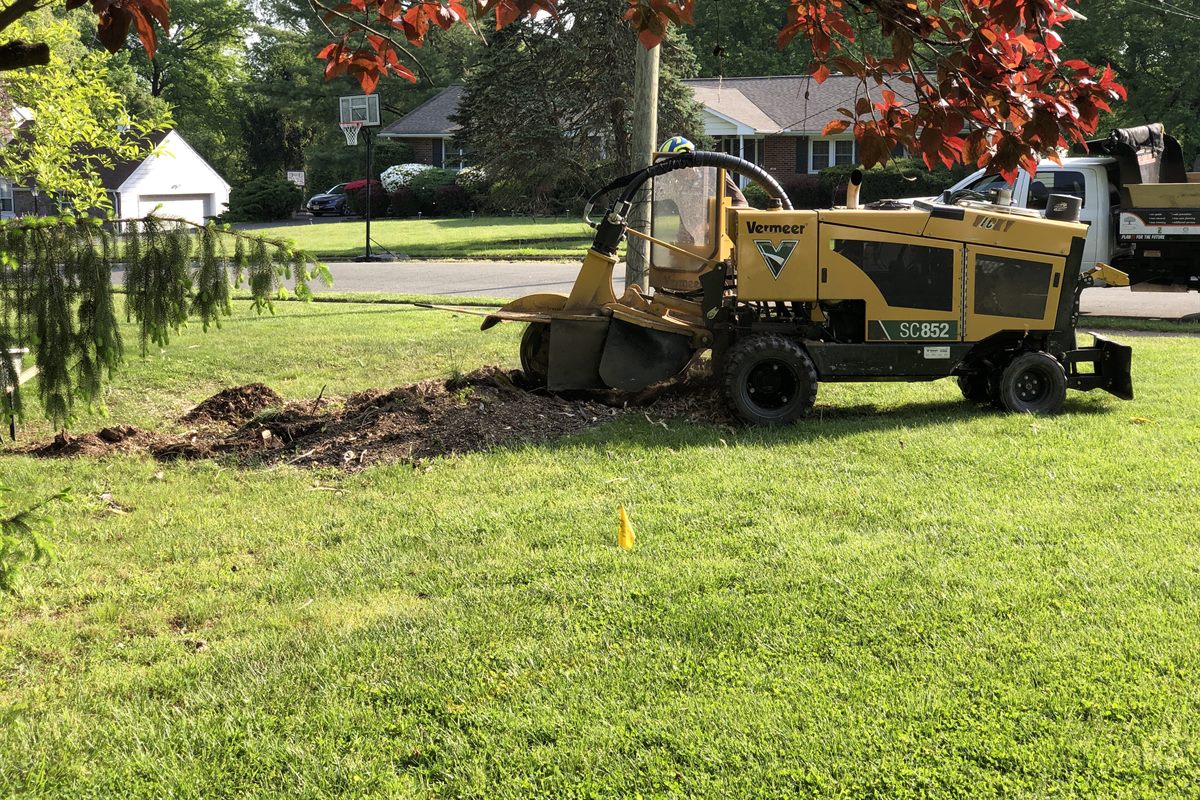
Once the tree is down, the stump is a separate machine and a separate line on the quote. Stump grinding is mechanical removal of the stump to six to twelve inches below grade, leaving the root system in the ground, and it is worth doing on the same visit rather than a second trip.
Frequently Asked Questions
How tall does a tree have to be to need a crane?
There is no height threshold, and any bidder who gives you one is guessing. A forty-foot dead pine that cannot be climbed may need a lift or a crane, while an eighty-foot healthy loblolly in an open Knightdale yard can often be felled in one piece. Condition and access decide it.
Is a crane safer than climbing?
For the trees it is chosen for, yes, and that is the point. A crane keeps a person out of unsound wood and keeps loads under control instead of swinging them through a canopy over your roof. On sound live trees with room to work, a climber with good rigging is equally safe and costs less, which is why method is matched to the tree rather than sold as an upgrade.
Does a crane cost more than rigging the tree down?
Per hour, yes. Per job, often not. The $2,500 to $6,000 and up band covers technical and crane-assisted work, and the reason a crane can land at the lower end of that is speed. A two-day rigging job compressed into a half day of picks changes the labour maths substantially.
Can you crane a tree out of a backyard with no gate access?
That is one of the classic reasons to use one. Lifting sections up and over the house to a street landing zone solves an access problem that no amount of hand-carrying solves cheaply. We do this work across Garner, Fuquay-Varina and the east Wake towns; tell us about the access when you call so the quote reflects the real plan.
My tree is over the house. Does that automatically mean a crane?
No, and this is the distinction most homeowners get backwards. A tree resting on or leaning over a roof that comes off with ground rigging in daylight is a large removal, not a technical one, and it prices in the large band. What pushes it into crane territory is the absence of usable rigging anchors or a travel path that has to clear the structure entirely.
Do I need an arborist before booking a crane removal?
Only if the decision to remove is still open. An arborist diagnoses condition and writes a report; a tree service removes the tree. If you already know it is coming down, go straight to bids. If you are not sure, our guide on choosing an arborist or a tree service sets out which one answers which question.
Get a Straight Method and a Straight Price for Your Tree
If you have a big tree in Garner, Clayton, Knightdale or Fuquay-Varina and you are trying to work out whether it is a climb, a lift or a crane pick, that answer comes from a walk of the property: the condition of the wood, the anchor points, the setup room and the travel path. We tell you the method we would use and why, then put an up-front written price against it.
Request a free written quote or call (919) 322-8083. Nothing starts until the scope, the debris handling and the stump are on the page in front of you.